
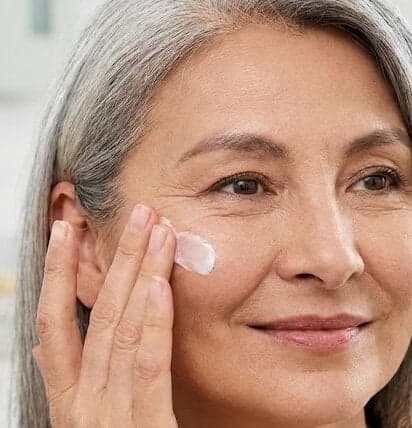
Mature skin often becomes drier, thinner and more reactive as collagen, oil production and cell turnover change with age. In Australia, years of UV exposure can also make pigmentation and texture changes more visible through the 40s, 50s and beyond.
An effective mature skin skincare routine is less about adding more products and more about choosing the right active ingredients at tolerable strengths. Tretinoin, niacinamide, hyaluronic acid, pigment-regulating ingredients and daily sunscreen can each play a role, but the right plan depends on sensitivity, skin tone, pigmentation pattern and treatment goals.
Key takeaways
- Hormones play a huge role: Estrogen loss leads to a rapid decline in collagen (up to 30% in the first five years of menopause), making potent actives essential.[1]
- Cell turnover slows down: As we age, our natural exfoliation process lags, leading to dullness. Retinoids are the gold standard for speeding this back up.[2]
- Hydration is structural: Mature skin holds less water. Ingredients like hyaluronic acid and ceramides are non-negotiable for maintaining a healthy barrier.[3]
- Pigmentation accumulates: Years of sun exposure often surface later in life as "age spots." Tyrosinase inhibitors like hydroquinone can help fade this accumulated damage.[4]
How mature skin behaves differently
| Skin Function | What happens with age | The Skincare Solution |
|---|---|---|
| Collagen Production | Slows significantly; skin becomes thinner and less firm. | Prescription Retinoids |
| Oil Production | Sebaceous glands shrink; skin becomes drier. | Rich Ceramides & Oils |
| Cell Turnover | Cycle extends from ~28 days to 45+ days; causes dullness. | Chemical Exfoliants & Retinoids |
| Pigment Regulation | Melanocytes become erratic; age spots appear. | Tyrosinase Inhibitors (Hydroquinone/Vitamin C) |
The collagen connection: Why skin thins
One of the most defining characteristics of effective mature skin skincare is addressing the loss of collagen. Collagen is the scaffolding that holds your skin up. Studies show that women lose about 30% of their skin collagen in the first five years of menopause, followed by a decline of 2% per year thereafter.[1]
When this scaffolding weakens, gravity takes over, leading to laxity (sagging) and the formation of deeper wrinkles. Over-the-counter peptide creams and moisturisers can support hydration and barrier comfort, but deeper texture and photoageing usually need ingredients with stronger evidence. Prescription retinoids, used carefully, are one option doctors may consider when the goal is to improve visible texture and support collagen renewal.
Ingredients with evidence for mature skin
For mature skin, the strongest routines tend to combine a few evidence-backed ingredients rather than chasing a long product list. These are the groups worth discussing with your prescriber.
1. Retinoids (Tretinoin)
Vitamin A derivatives are among the best-studied topical ingredients for texture, fine lines and photoageing. Retinoids, particularly prescription tretinoin, increase skin cell turnover and can signal the dermis to produce new collagen over time.[2]
Because mature skin can be drier and more reactive, prescription retinoids need a careful start-low approach. Used gradually, they can improve the appearance of photodamage and support a stronger-looking skin surface over time. We explain this in detail in our guide to retinol vs tretinoin.
2. Niacinamide (Vitamin B3)
As we age, skin can take on a yellow, sallow quality due to a process called glycation. Niacinamide is a powerful antioxidant that helps combat this yellowing while boosting the production of ceramides and fatty acids, which are crucial for keeping mature skin hydrated.[5] It is gentle and pairs beautifully with stronger actives.
3. Tyrosinase Inhibitors
Years of Australian sun exposure often result in mottled pigmentation or "liver spots" on the face and hands. To treat hyperpigmentation effectively, we use tyrosinase inhibitors. These ingredients stop the enzyme that creates melanin. Common options include prescription hydroquinone or over-the-counter options like kojic acid and ascorbic acid (Vitamin C). For deeper, stubborn spots, consult our guide on hydroquinone concentrations.
4. Hyaluronic Acid
Mature skin is thirsty skin. Estrogen loss reduces the amount of hyaluronic acid our bodies produce naturally. Applying it topically acts as a humectant, drawing moisture from the air (or your moisturiser) into the skin to plump up fine lines instantly.[3]
Adjusting your routine for sensitivity
A common challenge in mature skin skincare is that while you need stronger ingredients to see results, your skin barrier is often more fragile than it used to be. The lipid barrier—the oil that keeps good things in and bad things out—thins with age.
This means we cannot approach skincare with a "burn it off" mentality. Balance is key. At Prescription Skin, we often formulate prescription creams that combine potent actives with soothing agents. For example, we might prescribe Tretinoin compounded with Niacinamide and Hyaluronic Acid in a nourishing base. This allows you to get the anti-ageing benefits without the excessive peeling or irritation often associated with generic tubes.
The role of sun protection (It is not too late)
There is a myth that the damage is already done by the time you reach 50. This is false. Sun damage is cumulative, and UV rays continue to degrade collagen every single day you go unprotected. Furthermore, if you are using active ingredients like retinoids or treating melasma, your skin will be more photosensitive.[4]
A broad-spectrum SPF 50+ is the most effective anti-ageing cream you can buy. It preserves the collagen you have left and protects the new collagen you are building with your night cream.
How to start a prescription routine
Navigating the world of cosmeceuticals and prescriptions can be overwhelming. Store-bought creams often promise miracles but contain such low concentrations of active ingredients that they struggle to impact mature skin structure.
Our Australian doctors can assess your skin via a telehealth consultation. We look at your medical history, your specific concerns (whether that is deep wrinkles, redness from rosacea, or sun spots), and create a custom treatment plan. This might include a personalised night cream and advice on a supporting routine.
If you are ready to move beyond basic moisturisers and start a routine that works with your biology, you can begin your journey with our first 8 weeks guide to understand what the process looks like.
References
- Rzepecki AK, Murase JE, Juran R, Fabi SG, et al. Estrogen-deficient skin: The role of topical estrogens. International Journal of Women's Dermatology. 2019;5(2):85-90. ↩︎
- Mukherjee S, Date A, Patravale V, et al. Retinoids in the treatment of skin aging: an overview of clinical efficacy and safety. Clinical Interventions in Aging. 2006;1(4):327-348. ↩︎
- Papakonstantinou E, Roth M, Karakiulakis G. Hyaluronic acid: A key molecule in skin aging. Dermato-Endocrinology. 2012;4(3):253-258. ↩︎
- Bandyopadhyay D. Topical treatment of melasma. Indian Journal of Dermatology. 2009;54(4):303-309. ↩︎
- Bissett DL, Oblong JE, Saud A, et al. Topical niacinamide provides skin aging appearance benefits while enhancing barrier function. Journal of Clinical Dermatology. 2003;32:9-18. ↩︎
Medically Reviewed Content
- Written by: The Prescription Skin Editorial Team
- Medically Reviewed by: Dr Mitch Bishop AHPRA Registered Practitioner (MED0002309948)
- Last Updated: January 2026
This content is for informational purposes only and does not constitute medical advice. Treatment is subject to consultation and approval by our Australian-registered doctors.