- Key takeaways
- Hyperpigmentation After Inflammation: A Clear Definition
- How to Recognise Post-Inflammatory Dark Spots
- Acne, Burns, Injuries and Procedures: Common PIH Triggers
- Types of Post-Inflammatory Pigmentation: Epidermal Versus Dermal
- Treating Dark Marks Early, Once Inflammation Settles
- PIH Prevention Through Sun Protection, Calmer Skin and No Picking
- How Prescription Skin Reviews Your Skin Before Recommending Treatment
- When Post-Inflammatory Discolouration Needs a Dermatologist
- Summary
- Frequently asked questions
Hyperpigmentation post inflammation is the flat, darker patch that stays behind after a pimple, rash, burn or other skin injury has healed. Doctors call it post-inflammatory hyperpigmentation, or PIH. According to a focused review of how it develops, it's one of the most common acquired pigment disorders [1].
Inflammation switches on pigment cells called melanocytes, and laboratory research shows that damping down inflammatory signalling also reduces the pigment response [2]. That's why the mark sits exactly where the irritation was, and why it often outlasts the acne or eczema that caused it. Studies suggest PIH affects people with darker skin more often and more severely [3], though fair skin isn't immune, especially under strong Australian sun.
PIH belongs to the wider group of hyperpigmentation conditions, along with sun spots and melasma. It behaves differently, though, because inflammation is the starting point, not UV alone. That difference shapes how hyperpigmentation post inflammation is prevented, treated and monitored.
Key takeaways
- Hyperpigmentation post inflammation is a flat tan, brown or grey-blue mark left behind after acne, eczema, burns, injuries or skin procedures. It isn't a scar.
- Even mild acne can leave marks, so getting breakouts under control early is one of the most useful ways to prevent new spots.
- Brown epidermal marks usually fade over months. Grey-blue dermal pigment sits deeper, lasts longer and responds less to creams.
- Daily UV protection, a gentle routine and not picking matter as much as any active ingredient.
- Tretinoin and higher-strength hydroquinone need a doctor's prescription in Australia, and neither is used during pregnancy or breastfeeding.
Hyperpigmentation After Inflammation: A Clear Definition
Hyperpigmentation post inflammation is excess melanin left in the skin after inflammation has stimulated or damaged it. According to Maghfour and colleagues, chemical messengers released during a flare, such as prostaglandins, leukotrienes and cytokines, push melanocytes to step up melanin production and pass more pigment to surrounding skin cells [1]. Laboratory work points the same way. In a PIH model, blocking the NF-κB inflammatory pathway reduced both inflammation and melanin production [2].
The pigmentation itself is harmless, but it can look a lot like other marks. This comparison sets out the features that tell them apart.
| Mark | What causes the colour | Typical look | Helpful clue |
|---|---|---|---|
| Post-inflammatory hyperpigmentation | Excess melanin after inflammation or injury | Flat tan, brown, grey or blue-grey mark that matches the shape of the original spot or rash | A pimple, rash, burn or procedure happened at that exact site |
| Post-inflammatory erythema | Dilated or damaged small blood vessels, not melanin | Flat pink, red or purple mark | Often fades briefly when pressed and is more noticeable in fair skin |
| Melasma | Hormonal influences plus UV and visible light acting on melanocytes | Symmetrical brown patches on the cheeks, forehead or upper lip | No inflammation beforehand, and often linked to pregnancy or hormonal contraception |
| Sun spots | Years of cumulative UV exposure | Well-defined flat brown spots | Found on sun-exposed skin such as the face, hands and shoulders, with no prior rash |
Many healing spots show redness and brown pigmentation at the same time, so a mark can shift from pink to brown over a few weeks.
How to Recognise Post-Inflammatory Dark Spots
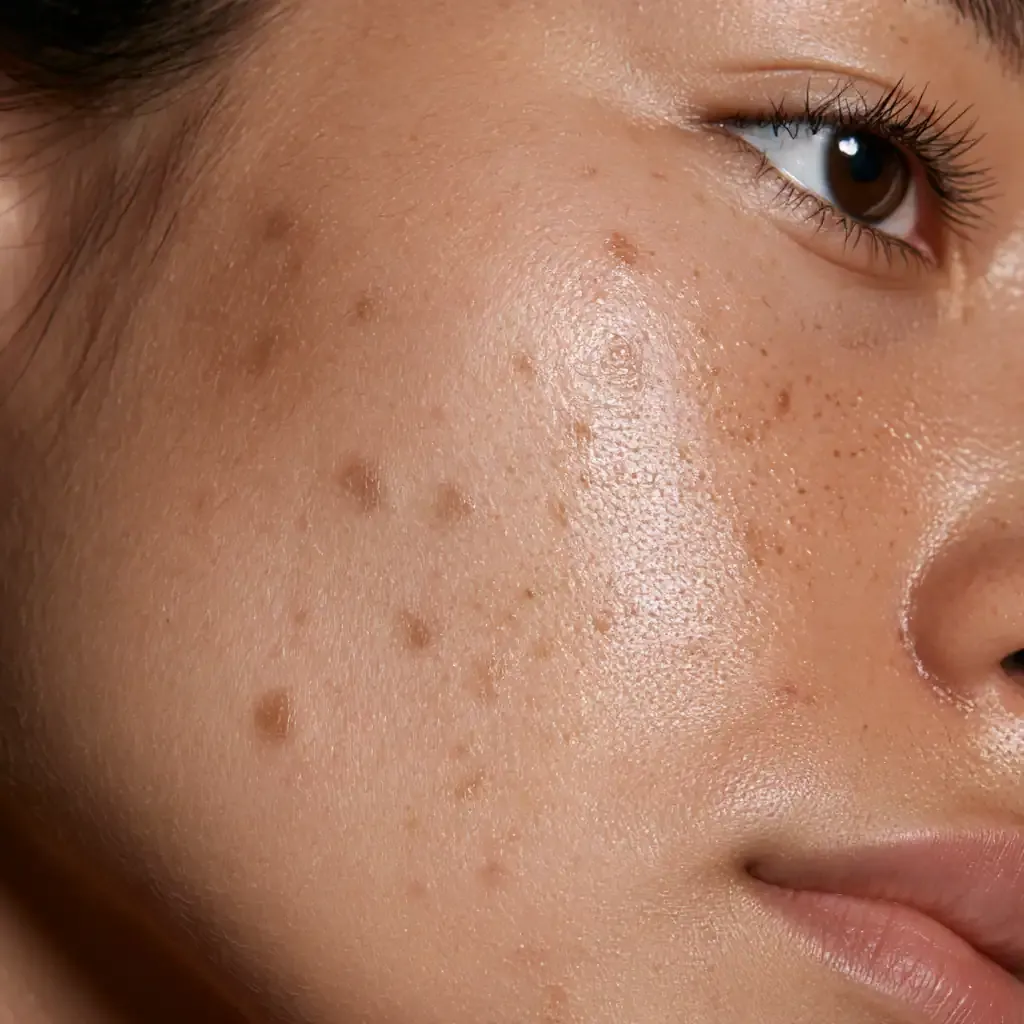
Post-inflammatory dark spots are flat, smooth marks sitting exactly where a pimple, rash or injury used to be. Run a finger across them and you shouldn't feel a dip or a bump, because a change in texture points to scarring rather than pigment. Signs consistent with hyperpigmentation post inflammation include:
- dark spots or patches in tan, brown, grey or blue-grey, with no itch or pain
- a shape that mirrors the original lesion, like a round mark after a pimple or a line after a scratch
- colour that deepens after sun or further irritation
- common sites: cheeks, jawline, chin, forehead, chest and back, plus arms and legs after bites, eczema or shaving rash
Post-inflammatory hyperpigmentation can overlap with redness in the same mark. According to an imaging study of inflammatory skin lesions, active redness and PIH can be mapped as separate features within a single lesion [4]. Dark spots are most often confused with melasma, sun spots, red post-acne marks and early scarring. Research shows uneven colour is a leading reason people book a skin consultation, particularly people with diverse skin types [5].
Acne, Burns, Injuries and Procedures: Common PIH Triggers
Acne is the most common trigger of hyperpigmentation post inflammation, but anything that inflames or injures the skin can set it off. According to a 2025 review of acne-induced PIH, marks can develop in mild to moderate acne even when there's no obvious inflammation on the surface [6]. That makes treating active acne early part of preventing pigment, not a separate job.
Common triggers include:
- acne, especially deep, cystic or picked spots
- eczema, dermatitis, psoriasis and insect bites
- burns from heat, chemicals or sunburn
- cuts, grazes, waxing and shaving rash
- cosmetic procedures such as lasers, peels, microneedling and injections
Procedures are easy to overlook. A published case described mottled pigmentation after mesotherapy injections [7], and research shows PIH is a common complication of skin trauma, particularly in skin of colour [8]. Clinical evidence indicates post-inflammatory hyperpigmentation is both more frequent and more severe in darker skin [3]. Sun exposure makes almost every trigger worse by keeping primed melanocytes active, and harsh, drying acne routines add their own irritation.
Types of Post-Inflammatory Pigmentation: Epidermal Versus Dermal
Post-inflammatory hyperpigmentation comes in two forms, epidermal and dermal, depending on how deep the extra pigment sits. Epidermal PIH lies in the top layer of skin, looks tan to dark brown and has fairly sharp edges. It's the more forgiving type and usually fades over months once the trigger and sun exposure are under control.
Dermal PIH forms when inflammation damages the base of the epidermis and pigment drops into the deeper dermis. According to a review of PIH pathophysiology, immune cells called melanophages then hold onto that pigment [1]. These marks look grey, slate or blue-grey, have softer edges and can persist for years.
Telling the two apart matters because creams work mainly on the epidermis. Doctors sometimes use a Wood's lamp, which makes epidermal pigment stand out more than dermal pigment. Studies suggest chemical peels and lasers can help deeper marks but carry a risk of irritation and new pigment in darker complexions [5]. Neither type involves collagen loss, so if there's a dent, that's a scar sitting alongside the pigment.
Treating Dark Marks Early, Once Inflammation Settles
Treating hyperpigmentation post inflammation means switching off the source of inflammation or injury first, then slowing new pigment and helping old pigment clear. According to a review of contemporary therapies, the main treatment classes act at different steps [3]:
- Tyrosinase inhibitors:hydroquinone, azelaic acid and kojic acid reduce new melanin. Higher strengths of hydroquinone need a doctor's prescription in Australia.
- Retinoids: tretinoin, one of the prescription-only retinoids, speeds up cell turnover so pigment sheds faster, and it also treats acne.
- Calming agents: niacinamide and tranexamic acid. A pilot study found topical tranexamic acid helped both prevent and treat PIH [8].
Each of these can cause irritation, and irritation in pigment-prone skin creates new discolouration, so strengths are built up slowly. Hydroquinone and tretinoin combinations usually run as 8 to 12 week courses and aren't used in pregnancy or breastfeeding. Before tranexamic acid, your doctor will ask about any history of blood clots.
At Prescription Skin, the pathway is an online skin analysis, a doctor's diagnosis and, where suitable, a custom prescription formula used alongside simple everyday skincare. Formulas don't fill in scars, and a more even skin tone takes months. Newer delivery systems are being developed to get actives deeper into the skin with less irritation [9].
PIH Prevention Through Sun Protection, Calmer Skin and No Picking
Preventing hyperpigmentation post inflammation comes down to three habits: protecting your skin from UV, keeping inflammation low and leaving lesions alone while they heal. According to a study using a UVB inflammation model, a sunburn reaction on its own can leave pigment behind [10]. Under Australian UV, that means broad-spectrum SPF 50+ every morning, reapplied outdoors, plus a hat. Tinted sunscreens containing iron oxides also block the visible light that darkens pigment in some skin types.
Calmer skin means fewer triggers. Treat acne and eczema early, introduce actives one at a time, and stop anything that stings or peels. Studies suggest that reducing inflammatory signalling also reduces pigment formation [2], which is why post-inflammation hyperpigmentation follows irritation so closely. Picking or squeezing drags out the healing process and deepens the injury, so marks after acne are often darkest where spots were picked (our guide on whether you should pop a pimple covers safer options).
Expect epidermal discolouration to fade over months, and deeper marks to take longer. Once the marks have faded, keep up the same gentle skincare, sun habits and prompt treatment of flares, because new irritation can bring fresh marks and undo a more even skin tone.
How Prescription Skin Reviews Your Skin Before Recommending Treatment
Prescription Skin starts with an online skin analysis, which an Australian-registered doctor reviews before any formula is suggested. You'll upload clear photos taken in natural light and answer questions about when the marks appeared and what came before them. You'll also be asked about your skin type, medications, pregnancy or breastfeeding plans and anything you've already tried, including chemical peels or clinic treatments.
The doctor's first job is working out what the discolouration actually is. Brown patches that follow the pattern of old pimples fit post-inflammation hyperpigmentation, symmetrical cheek patches suggest melasma, and red marks point to blood vessels rather than melanin. According to a 2025 review, managing acne-induced PIH includes controlling the acne itself [6], so active breakouts are treated alongside the pigment.
If a prescription formula suits you, the doctor chooses actives and strengths based on your complexion and how reactive your skin is, starting lower where irritation is likely. That matters because irritation from treatment can cause the very discolouration it's meant to fade. Where a formula isn't appropriate, for example with a changing spot or likely deep dermal pigment, you'll be advised to see a doctor in person. Approval is never automatic.
When Post-Inflammatory Discolouration Needs a Dermatologist
Post-inflammatory discolouration needs in-person review by a dermatologist when a mark doesn't behave like typical PIH or hasn't improved with sensible treatment. Book an appointment if you notice:
- a pigmented spot that's new, growing, changing in colour or shape, bleeding or itchy
- pigment with no clear rash, pimple or trauma at that site beforehand
- grey-blue marks that suggest deep dermal pigment
- dents, raised scars or ongoing nodular acne alongside the marks
- darkening after lasers, chemical peels or irritation from strong products
- little change after about 3 months of consistent treatment
According to a review of PIH therapies, post-inflammatory hyperpigmentation can be more severe and harder to manage in darker skin [3]. Studies suggest procedures on diverse skin types are best done by trained, experienced practitioners [5]. In Australia, you'll need a GP referral to claim a Medicare rebate for a specialist visit, and our guide on whether you need a referral for a dermatologist explains how that works.
Summary
Hyperpigmentation post inflammation is pigment left behind by acne, rashes, burns or procedures, and how deep it sits largely decides how fast it fades. Calming the original trigger and preventing new flares does as much as any cream. At Prescription Skin, the prescription skincare model means an Australian-registered doctor assesses hyperpigmentation post inflammation first and recommends a formula only when it's clinically appropriate.
You may also find these related guides helpful: Skin Tightening: Which Treatments Actually Firm Skin and What Glycolic Acid and Vitamin C Each Do for Your Skin.
Frequently asked questions
How long does post-inflammatory hyperpigmentation last?
Post-inflammatory hyperpigmentation usually lasts several months to a year when it sits in the top layer of skin, while deeper dermal marks can last for years. Fading slows if the original acne or rash keeps flaring, if the marks are picked or if they're exposed to UV. According to recent research, PIH remains a persistent management challenge [2], so steady prevention over months works better than chasing a quick fix.
How can I treat post-inflammatory hyperpigmentation?
You can treat post-inflammatory hyperpigmentation by calming the underlying inflammation, protecting your skin from UV every day and using ingredients that fade pigment. Useful options include azelaic acid, niacinamide and tranexamic acid, plus prescription tretinoin or higher-strength hydroquinone if a doctor thinks they suit you. Studies suggest chemical peels and lasers help in selected cases but can trigger new pigment in darker skin [5], so they should be done by experienced practitioners.
Can a doctor prescribe treatment for hyperpigmentation post inflammation online?
Yes, an Australian-registered doctor can assess hyperpigmentation post inflammation online and prescribe treatment when it's clinically appropriate. With Prescription Skin, you complete a skin analysis with photos and a health history, and the doctor decides whether a prescription formula is suitable. Some situations still need a face-to-face visit, such as an unusual or changing spot or suspected deep pigment. Pregnancy and breastfeeding also need a different plan, because hydroquinone and tretinoin aren't used then.
What race is more prone to hyperpigmentation?
People with medium to deep skin tones are more prone to hyperpigmentation, and this includes many people of African, South Asian, Middle Eastern, East Asian and Latin American heritage. Their melanocytes tend to respond to inflammation with a stronger, longer-lasting burst of melanin. Research shows PIH after skin trauma particularly affects people with skin of colour [8]. Skin type matters more than race itself, and fair skin can still develop PIH.
How to naturally fade hyperpigmentation?
Hyperpigmentation fades naturally as the skin renews itself, as long as you stop new pigment from forming. That means daily sunscreen and a hat, gentle cleansing, no picking, and treating breakouts or eczema early. Home remedies such as lemon juice, baking soda or undiluted essential oils often irritate the skin and can make PIH darker. If the marks haven't shifted after a few months, proven ingredients like azelaic acid or niacinamide are a reasonable next step.
What is post-inflammatory hyperpigmentation?
Post-inflammatory hyperpigmentation is darkening of the skin that develops after inflammation or injury, such as acne, eczema, a burn or a cosmetic procedure. Inflammation prompts pigment cells to make extra melanin, which leaves a flat tan, brown or grey mark where the problem was. Clinical evidence indicates it's among the most common acquired pigment disorders [1]. Because it isn't a scar, it usually fades with time and the right care.
References
- Maghfour J, Olayinka J, Hamzavi IH, Mohammad TF. A Focused review on the pathophysiology of post-inflammatory hyperpigmentation. Pigment cell & melanoma research. 2022. doi:10.1111/pcmr.13038. PubMed ↩︎
- Moon J, Moon IJ, Hyun H, Yoo JM, Bang SH, Song Y. Bay 11-7082, an NF-κB Inhibitor, Prevents Post-Inflammatory Hyperpigmentation Through Inhibition of Inflammation and Melanogenesis. Pigment cell & melanoma research. 2024. doi:10.1111/pcmr.13207. PubMed ↩︎
- Naik P. Getting to the Core of Contemporary Therapies for Post-Inflammatory Hyperpigmentation. Journal of drugs in dermatology : JDD. 2022. doi:10.36849/JDD.6485. PubMed ↩︎
- Saknite I, Kwun S, Zhang K, Hood A, Chen F, Kangas L. Hyperspectral imaging to accurately segment skin erythema and hyperpigmentation in cutaneous chronic graft-versus-host disease. Journal of biophotonics. 2023. doi:10.1002/jbio.202300009. PubMed ↩︎
- Sofen B, Prado G, Emer J. Melasma and Post Inflammatory Hyperpigmentation: Management Update and Expert Opinion. Skin therapy letter. 2016. PMID:27224897. PubMed ↩︎
- Auffret N, Leccia MT, Ballanger F, Claudel JP, Dahan S, Dréno B. Acne-induced Post-inflammatory Hyperpigmentation: From Grading to Treatment. Acta dermato-venereologica. 2025. doi:10.2340/actadv.v105.42925. PubMed ↩︎
- Zhou Z, Ge Y. Mottled hyperpigmentation caused by mesotherapy: successful treatment with a picosecond 1064 nm Nd:YAG laser. Journal of cosmetic and laser therapy : official publication of the European Society for Laser Dermatology. 2025. doi:10.1080/14764172.2025.2503935. PubMed ↩︎
- Masood M, Lane B, Maghfour J, Ceresnie M, Mokhtari M, Bardhi R. The efficacy of tranexamic acid in prevention and treatment of post-inflammatory hyperpigmentation: a pilot study. Clinical and experimental dermatology. 2026. doi:10.1093/ced/llag082. PubMed ↩︎
- Deb A, Sb S, B S, Hp SG, Aj R. Advancements in drug delivery for hyperpigmentation: emerging therapies and future prospects. Cutaneous and ocular toxicology. 2025. doi:10.1080/15569527.2025.2524683. PubMed ↩︎
- Siebenga PS, van Amerongen G, Klaassen ES, de Kam ML, Rissmann R, Groeneveld GJ. The ultraviolet B inflammation model: Postinflammatory hyperpigmentation and validation of a reduced UVB exposure paradigm for inducing hyperalgesia in healthy subjects. European journal of pain (London, England). 2019. doi:10.1002/ejp.1353. PubMed ↩︎
Medically Reviewed Content
- Written by: Prescription Skin Editorial Team
- Medically Reviewed by: Dr Mitch Bishop - AHPRA Registered Practitioner (MED0002309948)
- Last Updated: November 2026
This content is for informational purposes only and does not constitute medical advice. Treatment is subject to consultation and approval by our Australian-registered doctors.
Part of our condition guide
Hyperpigmentation →