- Key takeaways
- Skin Firming Treatment Options Available in Australia
- Signs of Skin Laxity and Lost Elasticity
- What Causes Sagging and Loose Skin
- Comparing Topical, Energy-Based and In-Clinic Approaches
- What Happens During a Skin Tightening Treatment Session
- Daily Habits That Help Prevent Skin Sagging
- When to See a Doctor About Loose Skin
- Summary
- Frequently asked questions
A skin firming treatment is any procedure or topical therapy designed to restore elasticity and reduce sagging. As we age, the production of collagen and elastin slows, and those two proteins are what keep skin looking taut and supported. When they decline you tend to see slack skin, fine lines and skin texture changes, and a general loss of firmness across the face and body.
Modern approaches can address these concerns without a surgical facelift. Whether you're dealing with mild slackening along the jawline or stubborn stomach skin after weight loss, a well-chosen skin firming treatment can help tighten skin and give a lifted look. Some people only need a topical routine to firm and smooth, while others get better value from an in-clinic device combined with prescription actives at home.
According to Kavali and colleagues, a topical firming moisturiser outperformed placebo on every measured skin parameter of the aged upper arm after 12 weeks, which tells you creams do something real but work slowly.[1] Research on cosmetic peptides points the same way, with acetyl dipeptide-31 amide increasing extracellular matrix components in preclinical work.[2] Retinoids remain the vitamin A derivatives most used to reverse the visible signs of photoageing.[3] Australian access matters too, since the strongest topicals here are prescription-only. Related reading includes first 8 weeks on prescription skincare, ascorbic acid, and salicylic acid BHA.
Key takeaways
- A skin firming treatment works by stimulating collagen in the deeper layers, which improves firmness and reduces sagging skin over time.
- Non-invasive options like radiofrequency, focused ultrasound and laser resurfacing produce gradual change with minimal recovery, while surgery remains the most effective route for genuinely excess skin.
- Prescription tretinoin has strong clinical evidence for rebuilding collagen and improving skin texture, and in Australia it needs a doctor's prescription rather than being sold off the shelf.
- Any tightening effect is not permanent, so most people need maintenance and a consistent topical routine to hold the benefit.
- Topical firming creams can measurably improve aged skin over about 12 weeks, but they lift far less than a device or an operation does.[1]
Skin Firming Treatment Options Available in Australia
Skin firming options in Australia fall into three groups: topical actives, energy-based devices, and surgery. Each one aims to tighten slack tissue by a different route, and a non-surgical plan suits mild to moderate change far better than it suits genuinely excess skin. Radiofrequency, focused ultrasound and laser skin resurfacing all heat the dermis to prompt collagen production, while topicals work more slowly on texture and fine wrinkle depth.
| Approach | How it works to tighten | Recovery | Typical use |
|---|---|---|---|
| Radiofrequency | Heat makes collagen fibres contract and stimulates new collagen | Minimal | Mild to moderate slackening, face and body |
| Focused ultrasound | Energy reaches deeper tissue to firm and lift | Minimal | Jawline, neck, brow |
| Laser resurfacing | Heat and surface renewal trigger collagen regeneration | Moderate to high with ablative devices | Texture plus a skin tightening effect |
| Prescription topicals | Retinoids support collagen and elastin production over months of nightly use[3] | None beyond early dryness | Maintenance and early slackening |
| Cosmetic firming creams | Peptides and moisturising actives improve firmness and smoothness modestly[1] | None | Body skin, adjunctive care |
Matching the method to the degree of slackening matters more than chasing the strongest device. A skin tightening and firming treatment aimed at surface texture won't lift a heavy jowl, and a home routine won't retract skin that has already stretched a long way.
Signs of Skin Laxity and Lost Elasticity
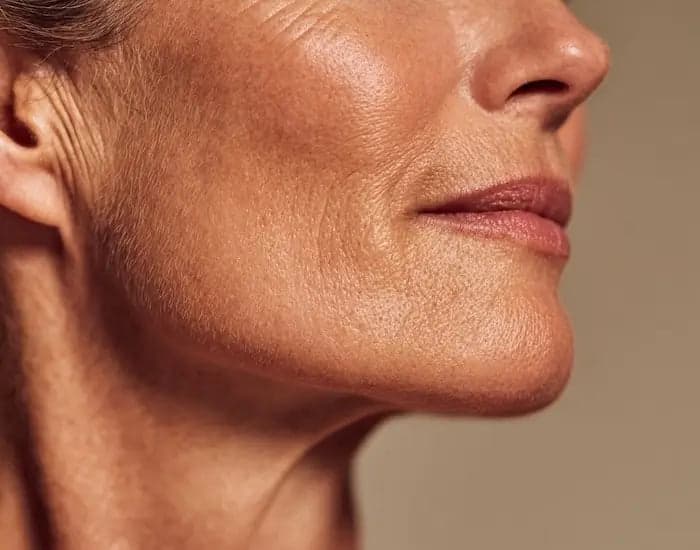
Skin laxity shows up as skin that no longer springs back, and the earliest sign is usually a softening of the jawline rather than a deep fold. Pinch the skin on the back of your hand and let go: slow recoil is consistent with reduced elasticity, though it isn't a diagnosis on its own. Loss of collagen and elastin tends to be gradual, so most people notice it in photographs before they notice it in the mirror.
- A blurred jawline or early jowling, often the first thing people want to tighten
- Crepey, finely wrinkled skin on the upper arms, inner thighs and knees
- Loose abdominal skin after pregnancy or weight loss
- A neck that looks lined even when the face still looks smooth
- Skin that creases and holds the crease instead of flattening out
Lax skin is often confused with volume loss, fluid retention, and simple sun damage, and each needs a different answer. Deep static wrinkle lines from photoageing may respond to a laser resurfacing procedure or a retinoid, while true excess skin will not.[3] A skin firming treatment that aims to stimulate collagen helps the first group far more than the second, so identifying which one you have decides whether skin tightening is worth the spend.
What Causes Sagging and Loose Skin
Sagging happens when the dermal scaffold thins and the fibres holding skin taut lose their spring. Collagen output starts falling from the mid-thirties, and cumulative UV exposure breaks existing fibres down faster than the skin replaces them, which is why sun-exposed sites sag first. Low-grade inflammation plays a part too: research on acetyl dipeptide-31 amide shows that reducing inflammatory mediators shifts genes tied to intrinsic skin ageing.[4]
Rapid weight loss is the other big driver. When volume drops quickly, stretched skin can't always retract, leaving slack tissue that no cosmetic cream will remove. Peptide work in this setting is framed as adjunctive care for laxity after weight loss rather than a substitute for a procedure.[2] Menopause reduces oestrogen and with it collagen support, so firmness can fall noticeably in that window.
Smoking, poorly controlled diabetes and repeated weight cycling all worsen the picture. A skin firming treatment for face concerns and a skin firming treatment for legs are rarely the same plan, since limb skin has less sebaceous support and tolerates a slower build. A non-invasive device or a topical that helps tighten early slackening is reasonable first, and a consultation for an in-clinic procedure is the comparison point when a topical clearly won't tighten enough. Firmer skin follows steady collagen stimulation, not a single session.[1]
Comparing Topical, Energy-Based and In-Clinic Approaches
The three approaches differ mainly in how deep they act and how much recovery they cost you. According to Konisky and colleagues, retinaldehyde with firming peptides improves texture and signs of photoageing, which is the realistic ceiling for a topical: better surface quality and some firmness, not a lift.[3] At-home skin firming treatments and cosmetic creams sit in the same tier, and clinical evidence indicates the gains are measurable but modest over 12 weeks.[1]
Energy-based work goes deeper. A laser skin tightening session or a radiofrequency course heats the dermis to stimulate collagen, and a laser treatment aimed at texture also carries a pigmentation risk in deeper skin tones that topicals don't. A clinic consultation is where you weigh that trade-off, along with cost, downtime, and whether surgery is the honest answer, since a clinic procedure is a bigger commitment than a nightly cream and isn't always the right first step.
Peptide research supports combining approaches, with anti-inflammatory peptides increasing dermal matrix components alongside other therapy.[4] For body sites, a skin firming treatment for legs usually leans topical because device coverage over a large area gets expensive fast. A skin tightening and firming treatment that pairs a device with prescription actives to tighten and hold the result generally outperforms either alone.
What Happens During a Skin Tightening Treatment Session
A skin tightening treatment session is short, and what happens depends entirely on the treatment class. With devices, a clinician cleanses the area, applies gel, and moves a handpiece over the skin while it warms; most people describe a hot, tolerable pulse. A tightening treatment course usually runs three to six sessions, because the collagen response builds over months rather than during the appointment itself.
The doctor-led topical pathway looks different. At Prescription Skin there's no session at all: you complete an online skin assessment, an Australian-registered doctor reviews your photos and history, and where it's clinically appropriate they prescribe a compounded formula. That's how to tighten skin gradually without a clinic visit, and the actives used are named plainly: tretinoin for collagen remodelling, niacinamide for barrier support, ascorbic acid as an antioxidant, and hyaluronic acid for hydration. Tretinoin is prescription-only in Australia, so a skin tightening plan built around it needs a doctor.
A skin tightening treatment isn't a single event either way. Expect the first visible change at four to eight weeks with a topical, and treat any device-based tightening treatment as the boost that a nightly skin tightening routine then protects. A free skin assessment is how that pathway starts.
Daily Habits That Help Prevent Skin Sagging
Preventing sagging is mostly about protecting the collagen you already have. Daily broad-spectrum sunscreen is the highest-value habit, since UV degrades collagen and elastin faster than almost anything else, and in Australia that applies through winter too. Studies suggest topical firming actives work best against that background, with measurable improvement in aged skin across a 12-week course.[1]
Beyond sun care, keep body weight reasonably stable, don't smoke, sleep properly, and eat enough protein and vitamin C. Retinoids used consistently are the one category of at-home skin firming treatment with real remodelling evidence behind them, and clinical evidence indicates they reverse visible photoageing over months of nightly use.[3] Cosmetic peptides can sit alongside them, with anti-inflammatory peptides shown to stimulate collagen-supporting matrix components in preclinical work.[4]
Maintenance is the part people skip. Skin firmness gained from a non-invasive laser skin tightening course or a topical will drift back if you stop, so plan for ongoing use and periodic top-ups rather than a finite course. Skin firming treatments for body sites need particular patience, since limb skin is slower to respond and collagen production there takes longer to shift. Realistically, judge results at three to six months, not three weeks.
When to See a Doctor About Loose Skin
See a doctor when loose skin appears suddenly, follows rapid weight loss, or hasn't budged after months of consistent over-the-counter care. Skin that bruises easily, stretches abnormally, or slackens alongside unexplained fatigue or weight change deserves proper assessment rather than another firming cream, because a few connective tissue and endocrine conditions present that way.
Medical review also matters when sagging comes with pigmentation or uneven tone, since some laser devices carry a higher risk of pigment change in deeper skin tones and can leave you worse off. If you have melasma, heat-based skin tightening can flare it, so the pigment needs a plan first. Pregnancy and breastfeeding rule out retinoids entirely.
For everyday firmness, a prescription routine that helps stimulate collagen is often the sensible step before any non-surgical device. The doctors at Prescription Skin assess skin online and, where clinically appropriate, build a formula around tretinoin and niacinamide to support collagen production, skin firmness and texture. Research shows retinoids remain the most used class for rejuvenation of photoaged skin,[3] and adjunctive peptides may add to that.[2] Skin firming treatments for body areas and a skin firming treatment for face concerns should be judged separately, and a doctor will tell you when a topical simply won't tighten enough.
Summary
Firming slack skin works best when evidence-based topicals, sensible sun protection and, where needed, an in-clinic device are combined rather than swapped. Topical firming actives and peptides produce real but gradual change,[1][2] while genuinely excess skin needs surgery. Prescription Skin's prescription skincare model lets Australian-registered doctors assess your skin online and create a custom formula where it's clinically appropriate.
Frequently asked questions
What is the best treatment for skin tightening?
The best treatment depends on how much slackening you have. For mild to moderate laxity, radiofrequency and focused ultrasound stimulate collagen with little downtime, while prescription retinoids have the strongest topical evidence for improving texture and signs of photoageing.[3] Genuinely excess skin needs surgery instead.
Can sagging skin be firm again?
Yes, mildly sagging skin can become firmer, though it rarely returns to how it looked a decade ago. Collagen-stimulating devices and steady retinoid use both improve firmness over months. Skin that stretched a long way during pregnancy or major weight loss usually needs surgical removal rather than tightening.
Can a doctor prescribe a skin firming treatment online?
Yes, an Australian-registered doctor can assess your skin online and, where clinically appropriate, prescribe a compounded formula for firming concerns. At Prescription Skin the doctors review your assessment and prescribe actives such as tretinoin and niacinamide, then the formula is compounded by a pharmacy partner and posted out.
Is there a skin tightener that actually works?
Yes, but expect gradual change rather than a lift. Prescription tretinoin has the best evidence of any topical, and cosmetic peptides such as acetyl dipeptide-31 amide increase dermal matrix components in preclinical testing.[2] Anything promising an overnight result is overselling.
Can sagging skin be tightened?
Sagging skin can be tightened to a degree, and the ceiling depends on severity and site. Facial and neck laxity responds reasonably well to energy devices plus nightly actives. Abdominal skin after significant weight loss responds least, because the tissue has physically stretched.
What vitamin deficiency causes sagging skin?
No single vitamin deficiency causes sagging skin, though severe vitamin C deficiency impairs collagen synthesis and protein malnutrition worsens skin quality. For most Australians, sun exposure, ageing and weight change explain laxity far better than diet does. Blood tests are only worth it if other symptoms suggest deficiency.
References
- Kavali CM, Nguyen TQ, Zahr AS, Jiang LI, Kononov T. A Randomized, Double-Blind, Split-Body, Placebo-Controlled Clinical Study to Evaluate the Efficacy and Tolerability of a Topical Body Firming Moisturizer for Upper Arm Rejuvenation. Aesthetic surgery journal. 2021. doi:10.1093/asj/sjaa134. PubMed ↩︎
- Lisante TA, Green B, Hubert K, Parsa R, Patel Shah A, Shuja Z. A Novel Cosmetic Anti-inflammatory Peptide With Firming and Lifting Benefits: The Potential for Adjunctive Care for Skin Laxity Associated With Weight Loss. Dermatologic surgery : official publication for American Society for Dermatologic Surgery [et al.]. 2026. doi:10.1097/DSS.0000000000005181. PubMed ↩︎
- Konisky H, Bowe WP, Yang P, Kobets K. The Clinical Efficacy and Tolerability of a Novel Retinaldehyde Serum with Firming Peptides to Improve Skin Texture and Signs of Photoaging. Journal of drugs in dermatology : JDD. 2024. doi:10.36849/JDD.8058. PubMed ↩︎
- Edison BL, Parsa R, Dufort M, Tierney NK, Green BA, Farris PK. Acetyl Dipeptide-31 Amide: A Novel Cosmetic Anti-Inflammatory Peptide That Demonstrates Anti-Aging, Firming, and Lifting Benefits. Journal of drugs in dermatology : JDD. 2025. doi:10.36849/JDD.8786. PubMed ↩︎
Medically Reviewed Content
- Written by: Prescription Skin Editorial Team
- Medically Reviewed by: Dr Mitch Bishop - AHPRA Registered Practitioner (MED0002309948)
- Last Updated: September 2026
This content is for informational purposes only and does not constitute medical advice. Treatment is subject to consultation and approval by our Australian-registered doctors.
Part of our condition guide
Fine Lines & Skin Texture →