- Key takeaways
- Forehead Acne at a Glance
- How to Spot Acne on the Forehead
- What Causes Forehead Breakouts and Their Acne Cause Triggers
- Types of Pimples and Lesions on the Forehead
- Active Ingredients That Clear Forehead Pimples
- Steps to Prevent Forehead Breakouts
- When to See a Doctor About Forehead Acne
- Summary
- Frequently asked questions
Forehead acne is acne that shows up across the upper face, along the hairline and between the brows, in a band of skin that carries a high density of oil glands. It forms the same way acne does elsewhere: follicles clog with dead skin cells and sebum, then Cutibacterium acnes bacteria multiply and the follicle wall inflames. According to a JAMA review, acne vulgaris is an inflammatory disease of the pilosebaceous unit that mostly affects the face and trunk and touches roughly 85% of people aged 12 to 24.[1]
The forehead is part of the T-zone, so it tends to run oilier than the cheeks and breaks out early. Research describes acne as a common inflammatory skin disease of the pilosebaceous units, which is why the same mechanisms explain a whitehead near your hairline and a deeper spot between your brows.[2] Studies also frame it as a chronic disorder of hair follicles and sebaceous glands, meaning forehead acne is usually a pattern to manage over time rather than a one-off event.[3] The good news is that most cases respond well once the right actives are matched to the type of lesion you have.
You may also find these related guides helpful: first 8 weeks on prescription skincare, prescription skincare during pregnancy, salicylic acid bha, and fine lines and wrinkles.
Key takeaways
- Forehead acne is ordinary acne in a high oil-gland zone, driven by blocked follicles, excess sebum, and Cutibacterium acnes bacteria rather than by poor hygiene.[1]
- Hair products, sweat under caps or fringes, and friction along the hairline are common local triggers that turn mild congestion into inflamed spots.
- Most forehead breakouts respond to consistent topical treatment; comedonal patterns and inflamed papules often need different active ingredients.[4]
- Persistent, scarring, or painful nodular acne is worth a doctor's review, since prescription options like topical retinoids and azelaic acid are only available after assessment in Australia.
Forehead Acne at a Glance
Forehead acne sits on a spectrum from tiny clogged pores to inflamed, tender spots, and knowing where yours falls helps decide what to do next. According to clinical reviews, acne is an inflammatory condition of the pilosebaceous unit, and comedone studies show the forehead correlates closely with other closed-comedone sites like the cheeks and chin.[5] The table below gives you a quick reference before we get into detail.
| Pattern | What you see | Typical starting point |
|---|---|---|
| Comedonal | Small whiteheads and blackheads, rough texture, little redness | Non comedogenic routine plus a topical retinoid to normalise shedding[4] |
| Inflammatory | Red papules and pustules, some tenderness and irritation | Topical antimicrobials and retinoids, reviewed by a doctor[6] |
| Mixed / persistent | Ongoing breakouts through and beyond puberty | Assessment for a combined acne plan |
Topical drugs have been used successfully against acne for decades, and a dermatologist or your treating doctor can match the class to your pattern rather than trialling one product after another.[2]
How to Spot Acne on the Forehead
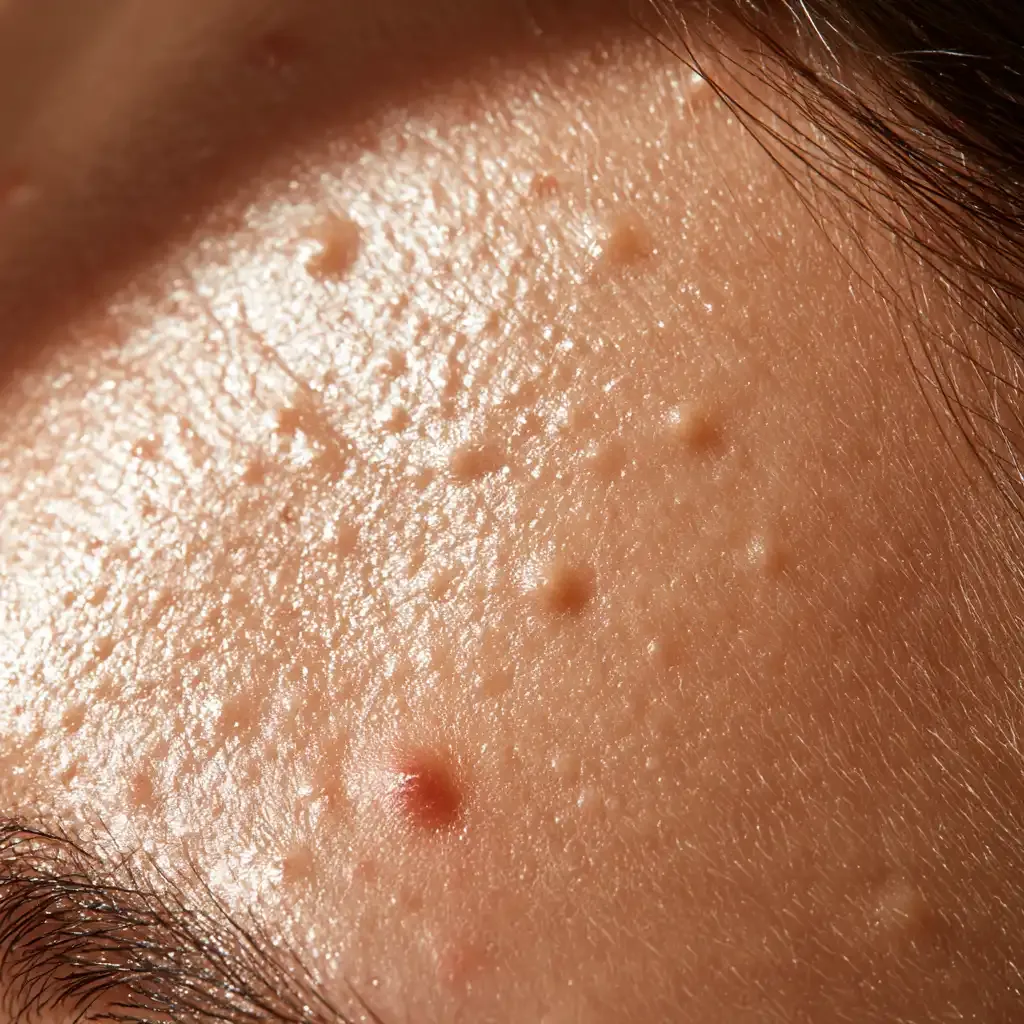
You can usually spot forehead acne by where it sits and how it feels, which tells you whether it's comedonal or inflammatory. Comedonal spots cluster along the hairline and between the brows as small bumps and blackheads with little redness, while inflammatory acne brings red papules and pustules that can feel tender. According to comedone-mapping work, closed comedones on the forehead track closely with the cheeks and chin, so a forehead breakout often signals a wider face pattern worth checking.[5]
Watch for spots that flare after workouts, since trapped sweat under a cap or fringe adds friction and warmth that suits the bacteria driving acne.[1] Research frames acne as a pilosebaceous disease, which is why a gentle cleanse morning and night helps more than scrubbing hard.[2] Studies note it's a chronic follicular disorder, so persistent congestion is common.[3] A steady non comedogenic skincare routine and, where appropriate, a topical retinoid such as tretinoin in Australia are the usual next steps once a doctor confirms the pattern.[6]
What Causes Forehead Breakouts and Their Acne Cause Triggers
The core acne cause on the forehead is a blocked follicle: dead skin and sebum build up, the pore stays clogged, and bacteria then inflame it. According to reviews of acne vulgaris, this happens in the pilosebaceous unit and is fundamentally an inflammatory process rather than a dirt problem.[1] Research describes the same follicular blockage as the shared acne cause across the face.[2]
Local triggers make the forehead worse than other areas. Heavy hair products and pomades migrate down onto the hairline, occlusive makeup can sit in the pore, and sweat plus friction from helmets or headbands add to the load. Studies confirm acne is a chronic disorder of the follicles and glands, so these habits tend to keep feeding it.[3] Switching to lighter, non-occlusive products, a simple cleanse routine, and consistent skincare gives clear skin a chance. Where topical care alone isn't enough, an azelaic acid prescription can help calm inflammation and unclog pores, and it's one of the actives our doctors can consider after an assessment. Topical therapy remains the backbone of treatment for this kind of acne.[6]
Types of Pimples and Lesions on the Forehead
Forehead breakouts come in a few distinct forms, and telling them apart helps you place your own skin. A comedone is a clogged pore: a blackhead is open and oxidises dark, a whitehead is closed and flesh-coloured. When bacteria and sebum inflame that follicle, you get a red papule, then a pustule with a white tip, and occasionally a deeper, painful bump or nodule. According to comedone analysis, closed comedones on the forehead correlate significantly with the cheeks, chin and upper back, so a single pimple rarely travels alone.[5]
Along the hairline you'll often see clustered small bumps from hair-product residue, which look comedonal rather than deeply inflamed. Deeper nodules that scar sit at the other end and need medical review. If your concern is more about lines than lesions, that's a separate track from the best anti ageing cream Australia or best anti wrinkle cream Australia searches; those target fine lines and skin texture, not acne. Matching the lesion type to a suitable skincare or prescription active is what actually clears a pimple.
Active Ingredients That Clear Forehead Pimples
The active ingredients that clear a forehead pimple work by unblocking the pore, cutting sebum, or calming inflammation. Topical retinoids speed up how dead skin sheds so a follicle stays clear; benzoyl peroxide reduces the bacteria that drive inflamed spots; and azelaic acid does both while easing redness. According to comedone-assay work, comedogenicity on the forehead tracks with sebum and porphyrin load, which is why sebum-targeting actives matter in this zone.[5]
A gentle, non-stripping cleanser and a genuinely comedogenic-free moisturiser support these actives rather than fighting them. For congestion, a beta hydroxy acid can loosen debris in a clogged, oily pore, and salicylic acid is a common choice for facial breakouts. Azelaic acid is prescription-strength in the formulas our doctors build, so it isn't something you'd pick off a shelf. The point is to match the ingredient to your lesion type instead of stacking everything at once, which usually just causes irritation.
Steps to Prevent Forehead Breakouts
Preventing forehead breakouts is about removing the daily loads that clog pores and staying consistent long enough to see results. According to acne reviews, this is an inflammatory disease of the pilosebaceous unit, so the aim is to stop follicles blocking in the first place.[1] Keep hair products off the hairline, wash your face after sweaty workouts, and choose non comedogenic formulas that won't leave a residue in the pore.
Rinse away sweat and dead skin promptly, since a warm, occluded forehead is exactly what can cause acne to flare. Research describes acne as a common inflammatory skin disease, which means flares are normal and don't signal failure.[2] Studies also frame it as chronic, so if you're acne prone, expect to maintain a routine rather than stop once skin clears.[3] Give any active six to eight weeks before judging it, because comedone turnover is slow.[5] Benzoyl peroxide can help hold inflamed spots at bay during maintenance if a doctor thinks it suits your skin.
When to See a Doctor About Forehead Acne
See a doctor about acne when over-the-counter skincare hasn't helped after a few months, or when spots are painful, scarring, or spreading. According to acne reviews, the condition ranges from comedones to inflamed papules, and the inflammatory end is where early treatment prevents lasting marks.[1] Deep nodules, cysts, and any acne that's affecting your confidence are all reasonable reasons to get a review of your face.
A doctor can look at what can cause acne in your case, from hair pomade and heavy makeup to sweat trapped under a fringe, and check whether excess sebum or non comedogenic product choices are the issue. Research confirms topical therapy is well established, so a targeted topical plan is often the next step.[6] Fixed-combination treatments can match your lesion type,[4] and comedone mapping shows the forehead rarely breaks out in isolation.[5] Prescription Skin runs an online skin assessment reviewed by Australian-registered doctors, who can build a prescription formula where it's clinically appropriate. Persistent acne is also framed as chronic, so ongoing care beats one-off fixes.[3] Whey protein has even been linked to male acne in a randomised trial, and probiotics with doxycycline have been studied for moderate cases, both signs that diet and adjuncts are worth discussing with your doctor.[7][8]
Summary
Acne is standard acne in an oil-rich zone, driven by blocked follicles and inflammation rather than poor hygiene.[1] Most cases settle with consistent, well-matched topical care, and persistent or scarring spots deserve a doctor's review.[2] Prescription Skin's online assessment lets Australian-registered doctors build a prescription formula when it's clinically appropriate for your skin.
Frequently asked questions
What is the main cause of forehead acne?
The main cause of acne is blocked hair follicles in a high-oil zone, where sebum and dead skin trap bacteria and trigger inflammation. Hair products along the hairline, sweat under caps, and occlusive makeup commonly make it worse, which is why the forehead breaks out earlier than drier areas of the face.
How do I get rid of my forehead acne?
To get rid of acne, keep a simple non comedogenic routine, remove hair-product residue from the hairline, and use a targeted active matched to your lesion type. Comedonal congestion usually needs a retinoid; inflamed spots may need antimicrobials or azelaic acid, ideally chosen with a doctor rather than stacked at random.
Can a doctor prescribe treatment for it online?
Yes, a doctor can prescribe acne treatment online in Australia through a service like Prescription Skin, where Australian-registered doctors review a skin assessment and create a prescription formula when it's clinically appropriate. Prescription-only actives are never issued without that consultation and approval.
What vitamin deficiency causes it?
No single vitamin deficiency is a proven cause of acne, and treating acne as a deficiency usually delays effective care. Diet and supplements can play a supporting role for some people, so raise any concerns with your doctor rather than self-diagnosing a deficiency.
Why am I breaking up on my forehead?
You're likely breaking out on your forehead because it's part of the oily T-zone, so it clogs quickly under hair products, sweat, and friction. Hormonal shifts, occlusive makeup, and inconsistent cleansing all add to the load, and a steady routine plus the right active usually settles it over several weeks.
References
- Eichenfield DZ, Sprague J, Eichenfield LF. Management of Acne Vulgaris: A Review. JAMA. 2021. doi:10.1001/jama.2021.17633. PubMed ↩︎
- Fox L, Csongradi C, Aucamp M, du Plessis J, Gerber M. Treatment Modalities for Acne. Molecules (Basel, Switzerland). 2016. doi:10.3390/molecules21081063. PubMed ↩︎
- Xu H, Li H. Acne, the Skin Microbiome, and Antibiotic Treatment. American journal of clinical dermatology. 2019. doi:10.1007/s40257-018-00417-3. PubMed ↩︎
- Gold MH, Baldwin H, Lin T. Management of comedonal acne vulgaris with fixed-combination topical therapy. Journal of cosmetic dermatology. 2018. doi:10.1111/jocd.12497. PubMed ↩︎
- Baek JH, Ahn SM, Choi KM, Jung MK, Shin MK, Koh JS. Analysis of comedone, sebum and porphyrin on the face and body for comedogenicity assay. Skin research and technology : official journal of International Society for Bioengineering and the Skin (ISBS) [and] International Society for Digital Imaging of Skin (ISDIS) [and] International Society for Skin Imaging (ISSI). 2015. doi:10.1111/srt.12244. PubMed ↩︎
- Kosmadaki M, Katsambas A. Topical treatments for acne. Clinics in dermatology. 2016. doi:10.1016/j.clindermatol.2016.10.010. PubMed ↩︎
- Sompochpruetikul K, Khongcharoensombat T, Chongpison Y, Rittirongwattana W, Asawanonda P, Noppakun N. Whey protein and male acne: A double-blind, randomized controlled trial. The Journal of dermatology. 2024. doi:10.1111/1346-8138.17109. PubMed ↩︎
- Atefi N, Mohammadi M, Bodaghabadi M, Mehrali M, Behrangi E, Ghassemi M. Evaluating the Effectiveness of Probiotic Supplementation in Combination With Doxycycline for the Treatment of Moderate Acne: A Randomized Double-Blind Controlled Clinical Trial. Journal of cosmetic dermatology. 2024. doi:10.1111/jocd.16614. PubMed ↩︎
Medically Reviewed Content
- Written by: Prescription Skin Editorial Team
- Medically Reviewed by: Dr Mitch Bishop - AHPRA Registered Practitioner (MED0002309948)
- Last Updated: July 2026
This content is for informational purposes only and does not constitute medical advice. Treatment is subject to consultation and approval by our Australian-registered doctors.
Part of our condition guide
Acne →