- Key takeaways
- Brightening Actives That Target Dark Patches
- What Age Spots Look Like on the Skin
- What Causes Age Spots and How They Differ From Freckles and Melasma
- Treatment Options for Pigmented Marks in Australia
- How to Fade Existing Discolouration Step by Step
- Preventing New Pigmentation With Sun Protection Habits
- About Prescription Skin
- In Clinic Laser Procedures for Pigment Removal
- Summary
- Frequently asked questions
Age spots fade when you combine a pigment-targeting active with strict daily sun protection and give it three to six months. That's the honest answer to how do I get rid of age spots, and it's the part most product packaging leaves out.
These flat brown marks are medically called solar lentigines. They form where melanocytes, the pigment-making cells in your skin, have been pushed into overdrive by years of ultraviolet light. Australian patients collect them earlier and in greater numbers than patients in most other countries, simply because of our UV index.
So when patients ask how do I get rid of age spots, the useful conversation isn't about one magic cream. It's about which class of active suits your skin, whether the mark is actually a lentigo rather than something that needs a skin check, and how you'll stop new spots replacing the ones you fade. Treatment also depends on skin tone, since some options carry a higher risk of rebound darkening in deeper Hyperpigmentation-prone skin.
Key takeaways
- Age spots (solar lentigines) are flat, benign patches of excess melanin caused by years of cumulative UV exposure, not by ageing alone.
- Fading them reliably takes a topical active, daily broad-spectrum sunscreen, and 12 to 24 weeks of consistent use. Nothing works in days.
- Prescription options such as tretinoin, hydroquinone and azelaic acid need a doctor's prescription in Australia and are only suitable for some patients.
- Any spot that is growing, changing colour, bleeding or itching should be checked by a doctor before you treat it as pigmentation.
- Pigment returns with sun, so SPF and a maintenance routine matter as much as the active itself.
Brightening Actives That Target Dark Patches
Actives that fade dark patches work in one of three ways: they slow melanin production, speed up how fast pigmented cells shed, or mop up the free radicals from sun exposure that trigger pigment in the first place. Knowing which lever an ingredient pulls answers how do I get rid of age spots far better than a label claim does.
| Active | How it works | Access in Australia | Common side effects |
|---|---|---|---|
| Hydroquinone | Blocks tyrosinase, directly reducing melanin output | Prescription-only, via Hydroquinone assessment | Irritation, rebound darkening if overused |
| Tretinoin | Accelerates cell turnover so pigmented cells shed faster | Prescription-only, see Retinoids | Peeling, dryness, sun sensitivity |
| Azelaic acid | Inhibits pigment enzymes and calms inflammation | Low strengths over the counter, higher strengths prescription-only | Tingling, mild stinging |
| Vitamin C (ascorbic acid) | Antioxidant that limits UV-driven pigment formation | Over the counter, see Ascorbic acid | Stinging on sensitive skin |
| Chemical peels | Controlled exfoliation lifts surface pigment | In clinic, or gentler at-home acids | Redness, post-inflammatory pigment |
Most effective plans stack two of these rather than relying on one.
What Age Spots Look Like on the Skin
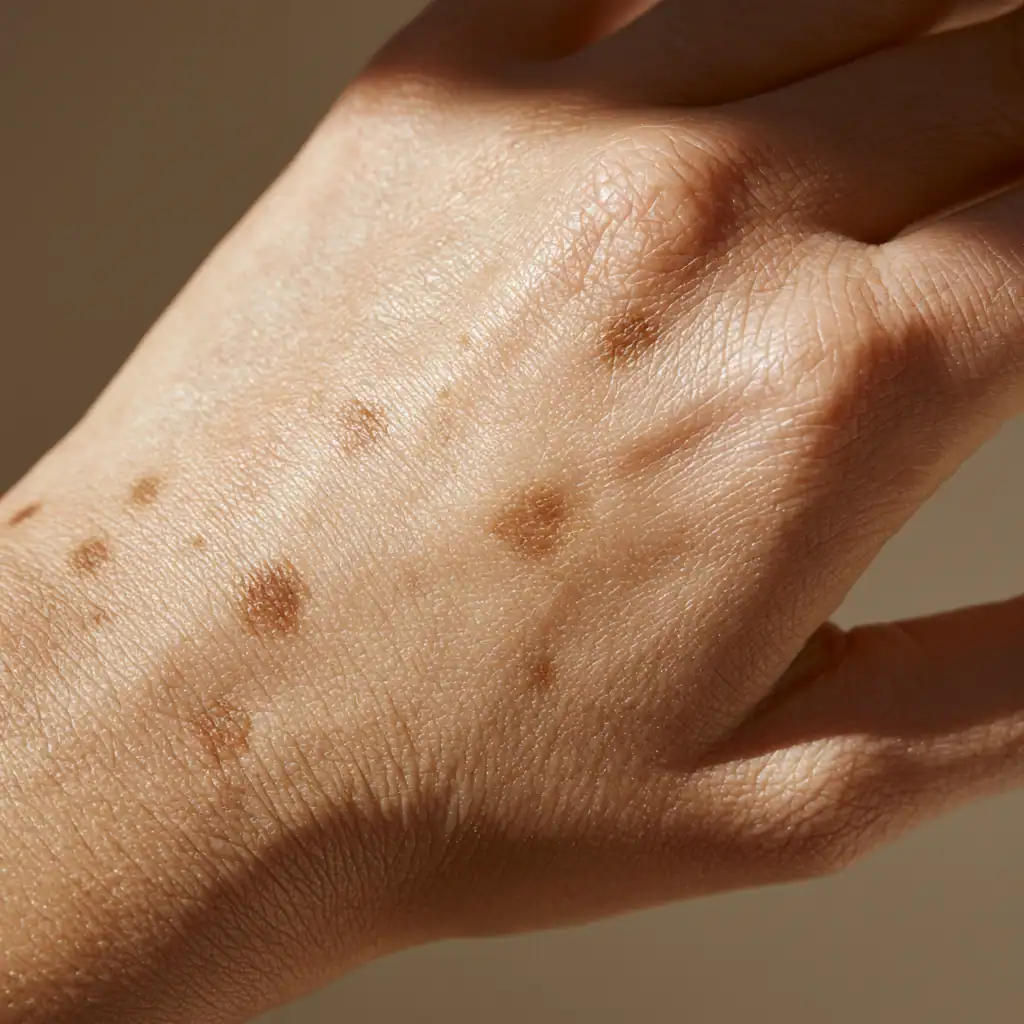
Age spots look like flat, evenly coloured tan to dark brown patches with a smooth surface and a fairly defined border, usually larger than a freckle. You can't feel them under your fingertip, and they don't itch or flake.
- Backs of hands, forearms, face, upper chest and shoulders: the areas with most sun exposure
- Colour ranging from light biscuit to near-black depending on your complexion
- Several spots clustered together rather than a single isolated mark
Features like these are consistent with solar lentigines, but they're not a diagnosis. Seborrhoeic keratoses, flat warty lesions and early melanoma can mimic them, so a changing, asymmetric or raised mark needs a doctor's eyes before any acid, peels or brightening routine goes near it. Answering how do I get rid of age spots starts with confirming that's what they are.
What Causes Age Spots and How They Differ From Freckles and Melasma
Age spots are caused by cumulative ultraviolet exposure, which makes melanocytes enlarge and permanently overproduce pigment in that patch of skin. Sun exposure is the driver; age just reflects how much of it you've had.
Freckles are genetic, darken seasonally and fade in winter, which is why How to Get Rid of Freckles: Fading and Prevention is a different problem. Melasma is hormonally driven and sits deeper. Age spots are harmless in themselves, though they signal UV damage, and skipping sunscreen or relying on peels alone is why many patients asking how do I get rid of age spots see them return.
Treatment Options for Pigmented Marks in Australia
Treatment for pigmented marks falls into three classes: topical actives, in-clinic resurfacing such as chemical peels, and device-based treatments including laser. According to research on photo-based dermatology therapies, light and laser treatments are used as noninvasive alternatives to medication, though they carry real risks of burns and post-treatment pigment change in darker skin [1].
Topicals remain the sensible first step for most dark spots. At Prescription Skin, you complete an online skin assessment, an Australian-registered doctor reviews your photos and history, and where it's clinically appropriate they prescribe a custom prescription skincare formula combining actives like tretinoin, hydroquinone or azelaic acid at strengths matched to your tolerance. Vitamin-based antioxidants and daily broad-spectrum sunscreen support the result and protect texture while actives do their work. Treatment always depends on consultation and doctor approval, and it isn't suitable for everyone, including during pregnancy.
How to Fade Existing Discolouration Step by Step
Fading existing discolouration works best as a staged routine rather than a pile of products started at once.
- Weeks 1 to 2: gentle cleanser, moisturiser and sunscreen only, to confirm your skin tolerates the basics.
- Weeks 2 to 6: introduce one prescribed active two nights a week, building up as tolerated.
- Weeks 6 to 24: nightly use if comfortable, with vitamin C in the morning to help lighten overall tone.
Chemical peels can be layered in later for stubborn marks. Expect spots to fade gradually, and limit sun exposure throughout, since fresh UV undoes the work. Our guide to the First 8 weeks on prescription skincare: how to use your cream covers what irritation is normal.
Preventing New Pigmentation With Sun Protection Habits
Preventing new pigmentation comes down to blocking the UV that causes it, every day, not just at the beach. Sunscreen applied properly is the single most effective part of any pigmentation plan, and under-application is the most common reason treatment stalls.
According to a systematic review of chemoprevention in adults with normal immune function, sun-related skin lesions respond to preventive strategies but the evidence base for individual agents varies widely [2]. Practically, that means a broad-spectrum SPF 50+ reapplied every two hours outdoors, a hat, and shade between 10am and 3pm.
Maintaining results is ongoing work. Most patients keep a low-dose active two or three nights a week long term, because stopping skincare entirely lets pigmentation drift back. Deeper hyperpigmentation treatment often needs years of sun discipline, which is also the answer to how to get rid of age spots and keep them gone.
About Prescription Skin
Prescription Skin is an Australian online service where doctors assess your skin and, where clinically appropriate, create a prescription formula for concerns like uneven skin tone and hyperpigmentation. You upload photos through an online skin assessment, and an Australian-registered doctor reviews them.
Formulas are built around your tone, your UV history and how much irritation you can tolerate, whether your marks are one shade darker than your base tone or considerably deeper. We don't perform lasers or peels, and we don't sell vitamin c serums off the shelf, though we'll tell you plainly where SPF and antioxidants fit alongside a prescription.
In Clinic Laser Procedures for Pigment Removal
Laser treatment for age spots works by firing light at a wavelength absorbed by melanin, fragmenting the pigment so your body clears it. According to a systematic review and meta-analysis of picosecond alexandrite lasers in melasma, pigment disorders affect people with darker skin types disproportionately and carry a real psychosocial burden, which is part of why device treatments are in demand [3].
Lasers suit discrete sun-related spots better than diffuse hyperpigmentation, and they don't stop new pigment forming. Broad-spectrum SPF and topical vitamin c still matter afterwards, because fresh UV exposure will repopulate treated skin. Evidence also shows very sun-sensitive patients, including those with albinism, need the most rigorous protection of all [4].
Summary
Age spots respond to a pigment-targeting active, daily sun protection and patience measured in months, with lasers and peels as options for stubborn marks [3][1]. Prescription Skin's model is simple: an online assessment, a doctor's review, and a prescription formula if it's clinically appropriate for your skin.
Frequently asked questions
What is the fastest way to get rid of age spots at home?
The fastest at-home approach is a nightly pigment-targeting active plus SPF 50+ every morning, and even that takes six to twelve weeks to show. Simple at-home treatments for age spots include vitamin C serums, niacinamide and low-strength azelaic acid. Scrubs and lemon juice don't help and often irritate.
Is there an age spot remover that actually works?
Age spot removers that work contain a real active with evidence behind it: hydroquinone, tretinoin, azelaic acid or vitamin C. Over-the-counter brightening serums give modest results. Prescription-strength formulas generally do more, but they need a doctor's assessment first and aren't right for every skin.
Why am I getting so many age spots all of a sudden?
A sudden crop of new spots usually reflects UV exposure from months or years ago finally showing, sometimes accelerated by hormones, certain medications or a recent summer outdoors. Any mark appearing quickly, changing shape or bleeding deserves a skin check rather than a cream.
Can you permanently get rid of age spots?
Age spots can be cleared, but not permanently guaranteed to stay away. Pigment cells in treated skin remain capable of overproducing melanin, so spots often return with renewed sun exposure. Ongoing sunscreen and a maintenance active are what keep results holding.
What is the number one dark spot remover?
No single dark spot remover ranks number one for everyone. Hydroquinone has the longest track record for fading lentigines, tretinoin suits patients also treating fine lines and wrinkles, and azelaic acid is gentler for sensitive or Rosacea-prone skin.
Does vaseline get rid of age spots?
Vaseline does not remove age spots. Petrolatum is an occlusive moisturiser that seals in water and supports the skin barrier, with no effect on melanin production. It's useful alongside irritating actives, not as a treatment for pigmentation itself.
References
- Ren X, Ge L, Song Z. Phototherapy for Acne Vulgaris: Strategies and Clinical Applications in Sebum Modulation, Inflammation Control, and Scar Management. Photobiomodulation, photomedicine, and laser surgery. 2026. doi:10.1177/25785478261438102. PubMed ↩︎
- Susanto A, Morgan E, Lindsay D, Collins LG. Chemoprevention of keratinocyte carcinomas and actinic keratoses in adults who were immunocompetent: a systematic review. Clinical and experimental dermatology. 2026. doi:10.1093/ced/llag073. PubMed ↩︎
- Chua KR, Vankayalapati DK, Shami MZ, Antoniou V, Nordahl EJB, Abdul-Aziz K. Assessing the Safety and Efficacy of Picosecond Alexandrite Lasers in the Management of Melasma: A Systematic Review and Meta-Analysis of Randomised Control Trials. The Australasian journal of dermatology. 2026. doi:10.1111/ajd.70051. PubMed ↩︎
- Tranquillini F, Soares VG, Mendes BX, Krish F, Franciscatti GC, Quaresma MV. Skin cancer and actinic keratosis in people with albinism: a systematic review and meta-analysis. Anais brasileiros de dermatologia. 2026. doi:10.1016/j.abd.2026.501374. PubMed ↩︎
Medically Reviewed Content
- Written by: Prescription Skin Editorial Team
- Medically Reviewed by: Dr Mitch Bishop - AHPRA Registered Practitioner (MED0002309948)
- Last Updated: October 2026
This content is for informational purposes only and does not constitute medical advice. Treatment is subject to consultation and approval by our Australian-registered doctors.