- Key takeaways
- Comedonal Acne Explained: How Clogged Pores Form
- Recognising Comedones on the Face and Body
- What Causes Non-Inflammatory Acne
- Types of Acne
- Active Ingredients That Clear Blocked Pores
- Preventing New Comedones From Forming
- When Congested Skin Needs a Doctor's Review
- A Simple Daily Routine for Congested Pores
- Summary
- Frequently asked questions
Comedonal acne is acne made up mostly of blocked pores rather than red, painful spots. The individual lesion is called a comedo, and you'll know them as blackheads and whiteheads scattered across the forehead, nose and chin.
According to a JAMA review of acne management, acne vulgaris is a disease of the pilosebaceous unit that affects roughly 9% of people worldwide and around 85% of those aged 12 to 24 [1]. Comedonal acne sits at the earlier end of that spectrum, and it responds to a different treatment emphasis than deep cystic disease [2]. Fixed-combination topicals have been studied specifically in this presentation [3].
Classification consensus work also groups congestion separately from papular and nodular disease, because the treatment ladder differs from the first step [4].
Key takeaways
- Comedonal acne is the non-inflammatory form of acne, made up of blackheads (open comedones) and whiteheads (closed comedones) rather than red, sore spots.
- It starts inside the hair follicle, where sticky keratin, dead skin cells and sebum block the pore before any bacteria or inflammation get involved.
- Topical retinoids remain the most useful first-line treatment because they act directly on the blocked follicle, and fixed-combination topicals can work about as well.
- Tretinoin needs a doctor's prescription in Australia and is not suitable in pregnancy or breastfeeding.
- Progress is slow by nature: expect 8 to 12 weeks before congestion visibly settles, and an initial purge along the way is common.
Comedonal Acne Explained: How Clogged Pores Form
A comedo forms when the lining of a hair follicle sheds sticky cells that mix with sebum and plug the pore. Research on the pilosebaceous unit shows this happens before bacteria and visible inflammation appear, which is why a clogged follicle can sit quietly for weeks before it ever becomes a papule [5]. Raised sebum production, hormones and comedogenic occlusion all feed into it, and comedo counts differ measurably between facial sites [6].
So the short version of what causes it: the main cause here is blockage, not infection [1]. The treatment follows that mechanism, which is why congestion is usually treated with a topical that normalises follicular shedding rather than an antibiotic [2]. A comedo-directed retinoid remains first line, and fixed combinations give comparable benefit [3]. In Australia, a tretinoin prescription has to come from a doctor, so over-the-counter salicylic acid is often where people start.
Here's how the usual options compare for acne.
| Option | What it does | Common trade-offs |
|---|---|---|
| Salicylic acid (over the counter) | Loosens the plug inside the pore | Mild dryness; often not enough alone [7] |
| Topical retinoid (prescription) | Normalises follicular shedding [3] | Peeling, purging, avoid in pregnancy |
| Azelaic acid (over the counter) | Anti-comedonal and calming; discussed on our azelaic acid page | Transient stinging; slower results |
Recognising Comedones on the Face and Body
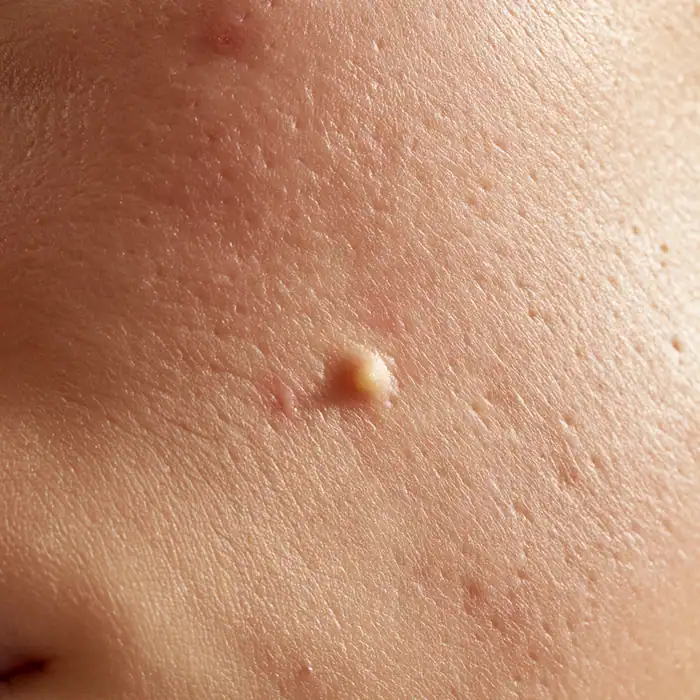
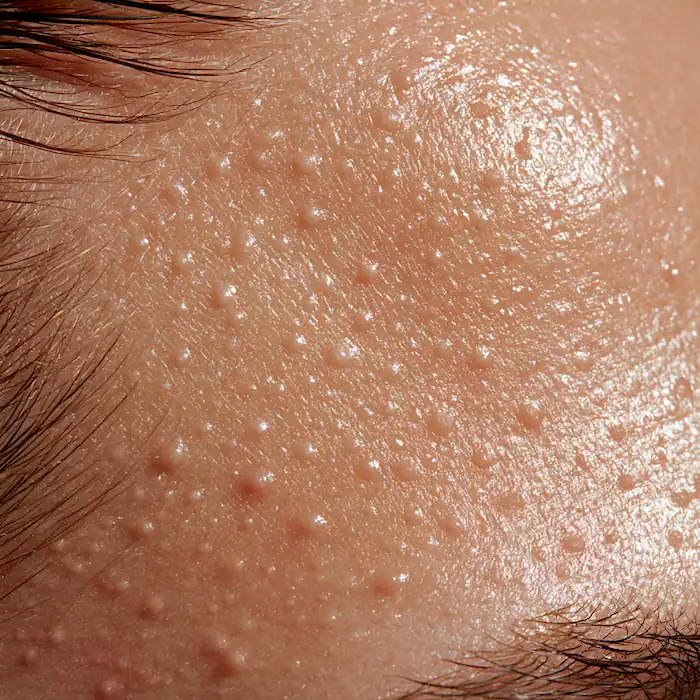
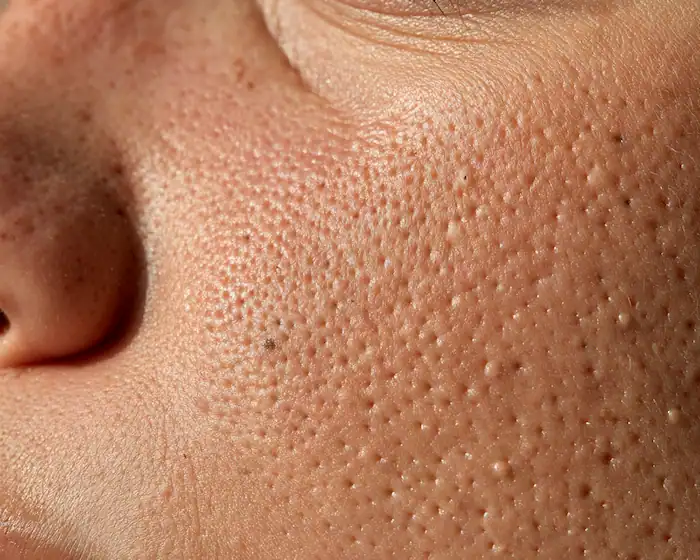
You can recognise comedonal acne by texture more than colour. An open comedo looks like a dark dot because the plug has oxidised at the surface, while a closed comedo is a small skin-coloured bump you feel before you see it [2].
According to comedogenicity research, closed comedo counts on the upper face correlate strongly with the cheeks, chin and upper back, so congestion on one part of the face usually predicts more elsewhere [6]. That's why treating a single comedone in isolation rarely holds; the whole affected face needs cover [3]. If a lesion turns red and tender it has become a papule, which signals inflammation has joined in [1]. Sebum-heavy zones are affected first [8].
What Causes Non-Inflammatory Acne
Non-inflammatory comedonal acne is driven by faulty shedding inside the follicle plus sebum that has nowhere to go [1]. Studies on the comedone switch suggest the plug forms first, and only later tips into inflammatory lesions such as a pustule or, less often, a cyst [8].
Heavy occlusive make-up, sweat under helmets or caps across the forehead, and thick anti-wrinkle products layered nightly can all worsen a closed comedo or open comedo [2]. Occupational occlusion is a documented aggravator in service personnel wearing gear for long shifts [9]. Even the best anti-ageing cream sold in Australia won't help if it's occlusive, and richer textures often need to come off while treatment settles [3].
Types of Acne
Sorting your type of acne matters because treatment follows the lesion. A comedonal type of acne means blocked follicles only: a closed comedo or open comedo, no redness [2].
Mixed acne vulgaris adds papules and pustules, and nodular disease involves deeper follicle damage that a doctor or dermatologist may treat systemically [1]. According to reviews of topical therapy, comedonal presentations respond well to topical treatment alone [7], while inflammatory forms often need antimicrobial cover of the follicle as well [5]. Naming your type of acne early keeps skincare choices sensible [3].
Active Ingredients That Clear Blocked Pores
The actives that clear a blocked pore are the ones that change how the follicle sheds. According to topical treatment reviews, retinoids are the anchor because they thin the plug and stop new lesions forming, and salicylic acid helps shift dead skin at the pore opening [7].
Fixed combinations have been shown to give comparable benefit in acne vulgaris, which matters if open comedones keep returning in the same pores [3]. Benzoyl peroxide earns its place once a pustule appears [1], though it shouldn't be paired with dapsone, and a light hyaluronic acid layer keeps the chin and jaw comfortable while sebum-directed actives settle in [2]. Site-specific counts support treating whole regions rather than single spots [6]. Prescription strengths of tretinoin need a doctor's assessment first, and an online skin assessment is how that starts.
Preventing New Comedones From Forming
Preventing a new comedo is maintenance, not a course you finish. Because a topical retinoid works on the hair follicle continuously, stopping it usually lets a comedo re-form within a couple of months [7].
Keep the nightly active going at a lower frequency, use non-comedogenic skincare, and let dead skin shed rather than scrubbing a blackhead or squeezing a pimple on the chin. Clinical evidence indicates steady comedo control beats intermittent bursts of treatment [3].
When Congested Skin Needs a Doctor's Review
Congested skin needs review when three months of sensible topical care hasn't shifted it. Book a review if a blackhead field across the forehead and cheek keeps returning, if inflammation and scarring appear, or if hair follicle blockage spreads to the back.
Research on comedogenicity supports treating the whole affected area, not one spot [6], and topical choices need adjusting when dead skin build-up and sebum persist despite treatment of the follicle [7]. Whey protein supplements have also been linked to acne in young men [10]. Note that people chasing the best anti-wrinkle cream often layer richer creams that worsen congestion [3].
A Simple Daily Routine for Congested Pores
Wash twice daily with a plain cleanser, moisturise lightly, and use sunscreen each morning to protect the pore lining while actives work.
At night, apply a pea-sized amount of your active to dry skin on the schedule in your treatment booklet: leave 3 days off between applications for weeks 1 and 2, 2 days off for weeks 3 to 5, 1 day off for weeks 6 and 7, then apply every night from week 8 if your skin is comfortable. Tretinoin is prescription-only across Australia, so a doctor or dermatologist decides the strength; you can read more in our guide to retinol vs tretinoin, and niacinamide pairs well for tolerance. Avoid scrubs, which irritate the follicle without reducing sebum production, dead skin or a stubborn blackhead on the forehead or in any congested pore [6].
Summary
Blocked follicles, not inflamed spots, drive this pattern, so treatment aims at how the pore sheds [1][2]. Prescription Skin works on the prescription skincare model, where Australian-registered doctors assess your skin online and prescribe a formula only when it's clinically appropriate.
Frequently asked questions
How do you get rid of comedonal acne?
You clear it by using a topical that changes how the follicle sheds, most often a retinoid, every night for at least 8 to 12 weeks. According to acne management reviews, congestion responds to topical therapy alone in most cases [1].
How is comedonal acne treated?
Treatment usually pairs a retinoid with a keratolytic such as salicylic acid, or uses a fixed-combination topical. Comparative data suggest combination products offer benefits similar to retinoid-based regimens [3].
Can a doctor prescribe treatment for comedonal acne online?
Yes. An Australian-registered doctor can assess your skin through an online skin assessment and prescribe a formula where it's clinically appropriate, though tretinoin isn't suitable during pregnancy or breastfeeding.
What is the main cause of comedonal acne?
The main cause is abnormal shedding inside the hair follicle combined with sebum, and what causes closed comedones specifically is that plug staying sealed under intact skin before any inflammation begins [2].
Which skin type gets comedones?
Oilier and combination skin types get the most comedones, though anyone using occlusive products can develop them.
What are closed comedones (whiteheads)?
Closed comedones are whiteheads: a comedo trapped under intact skin, so it feels like a small firm bump. Open comedones are blackheads, where the plug reaches the surface and darkens with oxidation.
References
- Eichenfield DZ, Sprague J, Eichenfield LF. Management of Acne Vulgaris: A Review. JAMA. 2021. doi:10.1001/jama.2021.17633. PubMed ↩︎
- Fox L, Csongradi C, Aucamp M, du Plessis J, Gerber M. Treatment Modalities for Acne. Molecules (Basel, Switzerland). 2016. doi:10.3390/molecules21081063. PubMed ↩︎
- Gold MH, Baldwin H, Lin T. Management of comedonal acne vulgaris with fixed-combination topical therapy. Journal of cosmetic dermatology. 2018. doi:10.1111/jocd.12497. PubMed ↩︎
- López-Estebaranz JL, Herranz-Pinto P, Dréno B, et al. Consensus-Based Acne Classification System and Treatment Algorithm for Spain. Actas Dermo-Sifiliográficas. 2017;108(2):120-131. doi:10.1016/j.ad.2016.10.001. PubMed ↩︎
- Xu H, Li H. Acne, the Skin Microbiome, and Antibiotic Treatment. American journal of clinical dermatology. 2019. doi:10.1007/s40257-018-00417-3. PubMed ↩︎
- Baek JH, Ahn SM, Choi KM, et al. Analysis of comedone, sebum and porphyrin on the face and body for comedogenicity assay. Skin Research and Technology. 2016;22(2):164-169. doi:10.1111/srt.12244. PubMed ↩︎
- Kosmadaki M, Katsambas A. Topical treatments for acne. Clinics in Dermatology. 2017;35(2):173-178. doi:10.1016/j.clindermatol.2016.10.010. PubMed ↩︎
- Saurat JH. Strategic Targets in Acne: The Comedone Switch in Question. Dermatology (Basel, Switzerland). 2015. doi:10.1159/000382031. PubMed ↩︎
- Brahe C, Peters K. Fighting acne for the fighting forces. Cutis. 2020. doi:10.12788/cutis.0057. PubMed ↩︎
- Sompochpruetikul K, Khongcharoensombat T, Chongpison Y, Rittirongwattana W, Asawanonda P, Noppakun N. Whey protein and male acne: A double-blind, randomized controlled trial. The Journal of dermatology. 2024. doi:10.1111/1346-8138.17109. PubMed ↩︎
Medically Reviewed Content
- Written by: Prescription Skin Editorial Team
- Medically Reviewed by: Dr Mitch Bishop - AHPRA Registered Practitioner (MED0002309948)
- Last Updated: August 2026
This content is for informational purposes only and does not constitute medical advice. Treatment is subject to consultation and approval by our Australian-registered doctors.
Part of our condition guide
Acne →