- Key takeaways
- Exogenous Ochronosis Explained: Blue-Black Pigment on the Skin
- Why Doctors Prescribe Hydroquinone for Melasma and Dark Patches
- How Hydroquinone Blocks Melanin and When It Backfires
- Who Hydroquinone Suits and Who Should Avoid It
- Who Is Most at Risk of Ochronosis?
- How Exogenous Ochronosis Develops
- How to Get Hydroquinone in Australia
- How to Use Hydroquinone Safely to Avoid Ochronosis
- Side Effects, Irritation and Safety Concerns With Hydroquinone
- Summary
- Frequently asked questions
Hydroquinone exogenous ochronosis is a rare skin reaction in which long-term use of topical hydroquinone causes the treated skin to darken instead of lighten, usually with a blue-black, grey-brown or slate-coloured tint. If you've been prescribed hydroquinone for melasma or hyperpigmentation, the term may have turned up in your reading, and it can sound alarming.
The reassuring part is how the reported cases actually look. Most published patients had used a high-concentration or unknown-concentration cream continuously for years, often bought without a script, and short supervised courses barely appear in the case literature at all. Duration of uninterrupted use, not the drug itself, is the consistent thread.
Two things make hydroquinone exogenous ochronosis worth understanding properly rather than fearing vaguely. First, the early stage looks so much like worsening discolouration that patients often respond by using more cream, which drives the problem forward. Second, once the deposit sits in the dermis it's stubborn, so recognising it early genuinely changes the outcome.
Australian practice leans on dermoscopy to separate this reaction from ordinary dermal discolouration before anyone reaches for a biopsy. According to a 2026 systematic review in the Australasian Journal of Dermatology, melasma is a chronic disorder that hits women and darker skin types hardest, which is the same group most likely to use lightening creams for long stretches.[1]
Key takeaways
- Hydroquinone remains one of the best-evidenced topical treatments for melasma, sun spots and post-inflammatory hyperpigmentation, and most dermatology literature still treats it as first line.
- Exogenous ochronosis is a rare paradoxical darkening of treated skin, and reported cases overwhelmingly involve years of continuous use at high or unlabelled concentrations.
- In Australia, hydroquinone above 2% is a prescription-only medicine, so a doctor's assessment is part of the pathway rather than an optional extra.
- Time-limited courses of roughly 8 to 12 weeks with a scheduled doctor review are the single most effective way to keep the risk low.
- If treated skin starts getting darker rather than lighter, stop the cream and get reviewed instead of applying more.
Exogenous Ochronosis Explained: Blue-Black Pigment on the Skin
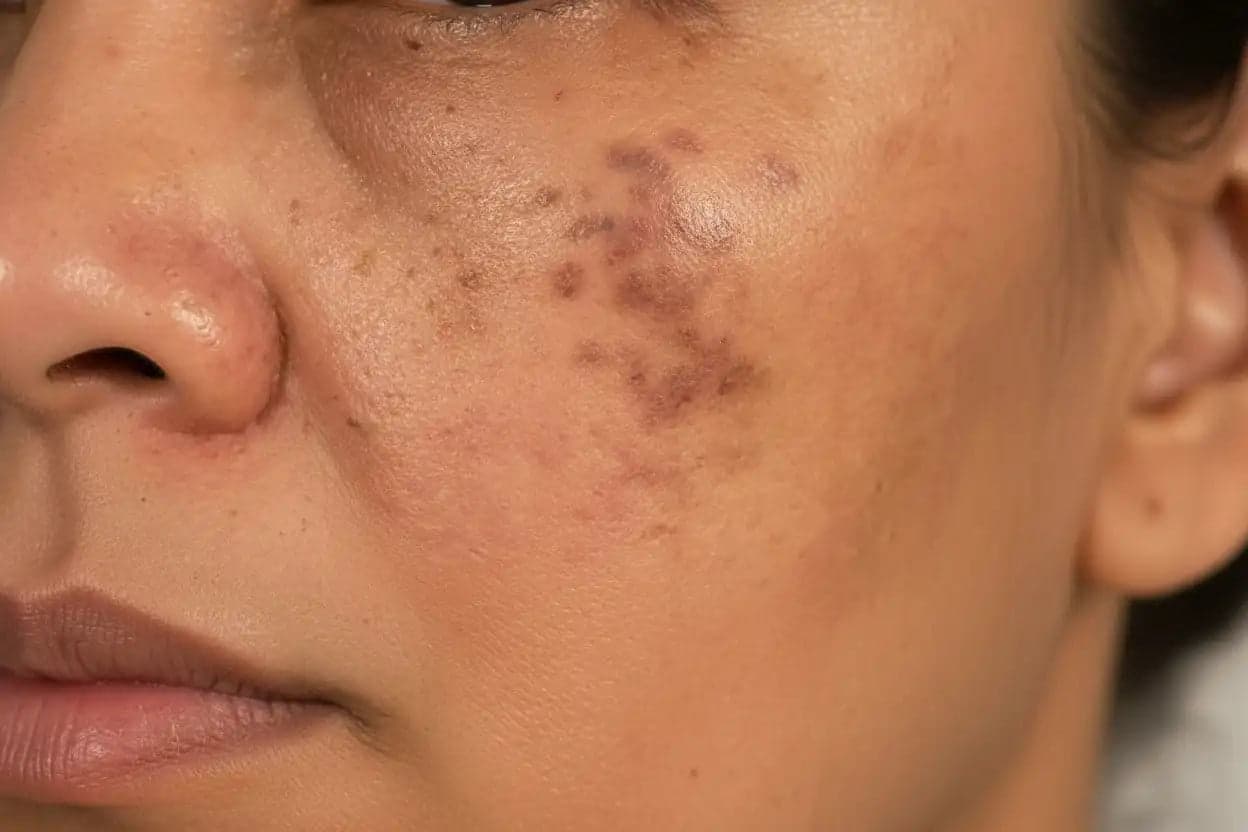
Exogenous ochronosis is blue-black, grey-brown or dark brown discolouration confined to the areas where the cream was applied, most often the cheeks, temples, forehead and jawline. Dogliotti described three progressive clinical stages in 1979, and recognising the first one matters because stopping hydroquinone early can prevent progression. Getting rid of it starts with permanent cessation of the trigger, then months of sun protection and prescription topicals, since nothing works while the cream is still going on.
Here is how the stages typically present and what patients notice at each point.
| Stage | Clinical signs | What you might notice |
|---|---|---|
| Stage I (early) | Mild redness and subtle hyperpigmentation limited to treated skin | Skin you were trying to lighten looks slightly darker or faintly reddish-brown, especially on the cheeks. Easily mistaken for a relapse of melasma. |
| Stage II (moderate) | Blue-black or grey-brown pigment, caviar-like papules, mild atrophy and telangiectasia | The colour deepens to a blue-grey or brown-black hue. Tiny raised bumps appear and the skin can look thinner with visible small vessels. |
| Stage III (advanced) | Firm papulonodular lesions and widespread reticulate discolouration | Hard lumps under the skin and a net-like pattern of darkening across the cheekbones and jawline. |
On dermoscopy, doctors look for irregular grey-brown globules that obscure the normal pigment network. Biopsy remains the confirmatory test, showing curved banana-shaped ochre fibres between degenerated collagen in the upper dermis, and published case series from Brazil describe the same histology. Because the deposit sits below the epidermis, the enzyme-blocking creams that help superficial colour do very little on their own, and a hydroquinone-free approach to skin lightening becomes the practical plan. According to a 2026 systematic review, microneedling with tranexamic acid or vitamin C is being studied in the dermatology literature for exactly this kind of stubborn facial pigment.[2]
Why Doctors Prescribe Hydroquinone for Melasma and Dark Patches
Doctors prescribe hydroquinone because it is still the best-evidenced topical depigmenting agent for melasma and post-inflammatory darkening, with more than 60 years of clinical use behind it. Most patients see meaningful lightening over 8 to 12 weeks, and results are stronger when hydroquinone is combined with tretinoin and a low-potency corticosteroid.
The reason it holds its place is that the alternatives are less convincing. According to a 2026 systematic review of natural products, melasma is a chronic relapsing hypermelanosis with high recurrence rates, which is why single-agent botanical treatments rarely hold their ground.[3] Research on platelet-rich plasma found no significant difference in severity compared with control therapy.[4] Evidence for microneedling with tranexamic acid is more promising but still limited to short-term tolerability data.[2]
Response depends on where the colour sits. Epidermal melasma and discrete post-inflammatory lesions do best, while deeper dermal deposits respond slowly, and case reports from Brazil make the same distinction for ochronosis skin changes. Topical hydroquinone suppresses melanin production while you use it, so without daily SPF 50+ the colour usually returns. Strength choices are covered in our guide to hydroquinone 2% vs 4% in Australia, and hydroquinone exogenous ochronosis remains a rare trade-off rather than a common one.
How Hydroquinone Blocks Melanin and When It Backfires
Hydroquinone blocks melanin by inhibiting tyrosinase, the enzyme melanocytes use to convert tyrosine into pigment, and at higher concentrations it is also directly toxic to melanocytes. That is why both strength and duration matter clinically.
Overuse backfires because the melanin-forming machinery doesn't switch off cleanly. Reactive metabolites accumulate in skin over months of uninterrupted topical application, and the classical explanation in the dermatology literature holds that local inhibition of homogentisic acid oxidase lets homogentisic acid build up and polymerise into dermal deposits. Once that has happened, more cream cannot lighten it, and exogenous ochronosis treatment becomes a slow project rather than a quick correction.
The failure mode I see most often is quiet escalation. Patients notice the topical cream has stopped working, increase the frequency, then wait another six months before asking, by which point subtle grey lesions have replaced the original hyperpigmentation and hydroquinone exogenous ochronosis is on the differential. Dermoscopy at that point usually settles the question, and Australasian dermatology reviews of picosecond lasers make the same point about accurate diagnosis before treating any pigmentary disorder with a device.[1] A 2026 meta-analysis of microneedling with tranexamic acid or vitamin C reflects the same shift toward non-hydroquinone options for long-term control.[2]
Who Hydroquinone Suits and Who Should Avoid It
Hydroquinone suits adults with epidermal melasma, sun-induced brown spots or post-inflammatory darkening who can commit to a defined course, daily sun protection and a review. It's not suitable in pregnancy or breastfeeding, or if you've reacted to it before.
Who Is Most at Risk of Ochronosis?
Ochronosis due to hydroquinone is reported disproportionately in Fitzpatrick skin types IV to VI, though it has occurred across all skin tones. Middle-aged women treated for facial patches make up most published cases, which mainly reflects who uses these creams longest, and clinical case series from several countries follow the same pattern.
Can 2% hydroquinone cause ochronosis? Rarely, and almost always after years of continuous use rather than a standard 8 to 12 week course. Risk clusters around a recognisable pattern: hydroquinone-induced darkening tends to follow prolonged application, products bought online with no concentration on the label, skin frequently exposed to ultraviolet light without protection, and no clinical review along the way. Unlike endogenous ochronosis in alkaptonuria, where homogentisic acid accumulates because of an inherited enzyme defect, the topical hydroquinone form is driven entirely by what you keep putting on your face.[2]
One caveat worth flagging. Persistent grey-brown facial patches aren't always ochronosis, and lichen planus pigmentosus, drug-induced colour change and stubborn dermal melasma can look almost identical on examination, so dermoscopy and a doctor's opinion beat a mirror. Australian dermatology practice generally starts with a lower strength, then decides whether to inhibit melanin further or switch to a hydroquinone-free plan to lighten the area.
How Exogenous Ochronosis Develops
The darkening comes from ochre-coloured deposits accumulating in the upper dermis, where they lodge between collagen fibres and can't be shed the way epidermal pigment can. That's the whole reason hydroquinone-induced hyperpigmentation behaves so differently from ordinary sun-related marks.
According to the classical model described in dermatology literature from India, hydroquinone locally inhibits homogentisic acid oxidase, allowing homogentisic acid to accumulate and polymerise into dermal deposits. Newer work questions that pathway and points instead to tyrosinase metabolising hydroquinone into reactive compounds that build up in skin, which is a genuine paradox given tyrosinase is the target the treatment is meant to block. Both models differ from endogenous ochronosis, where the defect is inherited rather than applied.
Both models agree on the practical point. Prolonged uninterrupted use is what drives hydroquinone-induced ochronosis, with high or unlabelled concentrations and patchy sun protection adding to it. Reviews of alternative approaches such as acupuncture and herbal therapy found no statistically significant improvement in facial colour, which is a useful reminder that swapping to unproven options isn't a safety strategy either.[5] Evidence-based non-hydroquinone actives, including niacinamide and azelaic acid, are the sensible way to keep treating hyperpigmentation during breaks.[2]
How to Get Hydroquinone in Australia
In Australia, hydroquinone at concentrations above 2% is a prescription-only medicine, so you need a consultation with an Australian-registered doctor before it can be compounded for you. Creams of 2% or less are pharmacy medicines, and the TGA has consulted on tightening consumer access further.
Compounded formulas are not subsidised on the PBS, so expect to pay privately. Buying from unregulated overseas websites is the clinical problem behind most published cases, because the strength is unverifiable and the use of hydroquinone then continues for years without review, which is exactly the prolonged pattern that ends in ochre deposits settling among collagen fibres in the dermis as exogenous ochronosis.
Dermatology reports from Australia and India agree that supervised courses look very different from unsupervised ones, and homogentisic acid deposits turn up where nobody is checking progress. Our free skin assessment collects your history and photos for a doctor to review, and treatment for hyperpigmentation goes ahead only where it's clinically appropriate. If hydroquinone isn't suitable, a doctor can still plan a formula built around actives that lighten hyperpigmentation without it, such as azelaic acid or tranexamic acid, and comparative data on those options continues to grow.[2]
How to Use Hydroquinone Safely to Avoid Ochronosis
Safe use of hydroquinone comes down to three variables: the lowest effective concentration, a thin layer on affected areas only, and a defined end date. Most Australian doctors prescribe 2% to 4% once daily at night for 8 to 12 weeks, then review before any repeat.
Apply after cleansing, on dry skin, to the patches themselves rather than the whole face. Rubbing it everywhere lightens normal skin around the marks and creates a patchy halo, and it also multiplies the total exposure that matters for ochronosis risk. Start every second night for the first week or two if your skin stings, then build to nightly as tolerated.
Pair it with a broad-spectrum SPF 50+ each morning and a bland moisturiser. Avoid stacking strong exfoliating acid products on the same nights, since irritation drives more hyperpigmentation in the skin types most likely to be treated. Benzoyl peroxide can temporarily stain hydroquinone-treated skin, so keep them apart. A defined break after three to six months, with a hydroquinone-free maintenance formula such as azelaic acid, kojic acid or a topical retinoid, is how you avoid exogenous ochronosis while continuing skin lightening.
Hydroquinone can cause exogenous ochronosis, and the risk sits almost entirely with prolonged unsupervised use, so the review appointment is the real safeguard. If treated skin develops a grey or ochre cast, stop that night. Dermatology assessment then guides what comes next, and dermatology reviews of picosecond lasers in Australasia show device options exist for selected patients once the cream has stopped and deposits remain in the dermis.[1] Our note on your first 8 weeks on prescription skincare covers what review appointments involve. Homogentisic acid chemistry sits behind the classical explanation of why the colour stays put.[2]
Side Effects, Irritation and Safety Concerns With Hydroquinone
The common side effects of hydroquinone are mild and local: stinging on application, dryness, mild redness and occasional irritant or allergic contact dermatitis. Most settle with less frequent application, a plain moisturiser and a short pause.
Serious problems are uncommon under supervision. Cosmetic safety reviews of hydroquinone concluded that adverse effects in monitored patients are mostly mild and local, with ochronosis reported rarely relative to the enormous number of courses prescribed. Unwanted skin lightening of the surrounding normal skin is the more frequent nuisance in clinical practice, particularly where the cream has been spread beyond the patch.
Topical hydroquinone shouldn't be used in pregnancy or breastfeeding, or where there's known hydroquinone sensitivity. Tell your doctor about any acid-based exfoliants, benzoyl peroxide or acne treatment you're using at the same time. Patients with a thromboembolic history need a different plan again if tranexamic acid is being considered as the alternative.
The safety concern that actually matters is prolonged unmonitored use, where homogentisic acid deposits can settle in the dermis and hyperpigmentation deepens rather than fades, the mechanism dermatology reviews attribute to local homogentisic acid oxidase inhibition. Clinical evidence indicates that even device-based options for stubborn colour need careful patient selection, with meta-analysis of platelet-rich plasma showing no significant benefit over control therapy[4] and picosecond laser data reported cautiously in Australasian dermatology.[1] Enzyme-level effects on the melanocyte are reversible; dermal deposits largely aren't.[2]
Summary
Hydroquinone exogenous ochronosis is a rare, stubborn paradoxical darkening tied overwhelmingly to years of unsupervised high-strength use, not to a short doctor-led course. Because facial hypermelanosis relapses so readily, the sensible plan is a defined treatment window, daily sun protection and a review before any repeat, with non-hydroquinone actives in between.[3] Prescription Skin works through exactly that prescription skincare model: an online assessment, a doctor's review, and a custom formula where it's clinically appropriate, so hydroquinone exogenous ochronosis stays the rarity it should be.[2]
Frequently asked questions
Can 2% hydroquinone cause ochronosis?
Yes, but it's very rare at 2% and essentially confined to years of continuous use rather than a standard 8 to 12 week course. Most published cases involved higher or unlabelled concentrations bought without a script. A time-limited course at 2% under review is considered low risk in routine dermatology practice.
How do you prevent ochronosis when using hydroquinone?
You prevent ochronosis by keeping courses time-limited, using the lowest effective strength, applying it only to the affected patches, and wearing SPF 50+ daily. Book a review at 8 to 12 weeks instead of repeating a script indefinitely. What not to do is rub hydroquinone over the whole face, skip sunscreen, or keep going without a doctor looking at the skin.
Can a doctor prescribe treatment for hydroquinone exogenous ochronosis online?
Yes, an Australian-registered doctor can assess suspected hydroquinone exogenous ochronosis through an online consultation with good-quality photos and prescribe treatment where it's clinically appropriate. Some presentations need in-person dermoscopy or a biopsy to confirm the diagnosis, and your doctor will tell you if that's the case. Our FAQ page explains how that review works.
How do you get rid of exogenous ochronosis?
Ochronosis can be treated, but improvement is gradual and often incomplete, so expectations matter. Stopping hydroquinone permanently comes first, because nothing improves while the trigger continues. From there it's strict sun protection plus topicals such as tretinoin, azelaic acid or ascorbic acid, and laser in selected cases.[2]
What are the early signs of ochronosis?
The earliest sign is mild redness with faint darkening of the skin you were trying to lighten, usually on the cheeks or temples. Because it mimics a relapse, patients often apply more cream, which is the wrong move. Tiny caviar-like bumps or a blue-grey cast mean the reaction has progressed further, and clinical staging then guides treatment.
Can hydroquinone cause exogenous ochronosis?
Yes, prolonged topical hydroquinone can cause exogenous ochronosis, though it's uncommon and heavily linked to duration. The benefits of hydroquinone for pigmentation and melasma are still real and well documented, and comparative research shows alternatives such as platelet-rich plasma performed no better than control.[4] To keep the risk of ochronosis low, treat the patches only rather than the whole face, on a defined course with follow-up.[3]
References
- Chua KR, Vankayalapati DK, Shami MZ, Antoniou V, Nordahl EJB, Abdul-Aziz K. Assessing the Safety and Efficacy of Picosecond Alexandrite Lasers in the Management of Melasma: A Systematic Review and Meta-Analysis of Randomised Control Trials. The Australasian journal of dermatology. 2026. doi:10.1111/ajd.70051. PubMed ↩︎
- Roddaje T, Saowarat S, Norchai P. Efficacy and safety of microneedling with tranexamic acid versus microneedling with vitamin C in the treatment of melasma: a systematic review and meta-analysis. Journal of medicine and life. 2026. doi:10.25122/jml-2026-0051. PubMed ↩︎
- Morais MT, Gonçalves TLN, de Paula Soares L, Sato AFQ, Oliveira Júnior RG, Silva Almeida JRGD. Efficacy of natural products in the treatment of melasma: A systematic review. Biomedicine & pharmacotherapy = Biomedecine & pharmacotherapie. 2026. doi:10.1016/j.biopha.2026.119763. PubMed ↩︎
- Ma C, Wang Q, Zhang L. The Efficacy and Safety of Platelet-Rich Plasma in the Treatment of Melasma: A Systematic Review and Meta-analysis. Aesthetic plastic surgery. 2026. doi:10.1007/s00266-026-05946-5. PubMed ↩︎
- Dai Y, Li G, Hao P. Comparative effectiveness of acupuncture, fire needle, and herbal therapies for melasma: A Bayesian network meta-analysis. Medicine. 2026. doi:10.1097/MD.0000000000048240. PubMed ↩︎
Medically Reviewed Content
- Written by: Prescription Skin Editorial Team
- Medically Reviewed by: Dr Mitch Bishop - AHPRA Registered Practitioner (MED0002309948)
- Last Updated: September 2026
This content is for informational purposes only and does not constitute medical advice. Treatment is subject to consultation and approval by our Australian-registered doctors.
Part of our ingredient guide
Hydroquinone →