- Key takeaways
- What Inflammatory Acne Is and What Red, Swollen Breakouts Mean
- How Doctors Diagnose Inflammatory Acne by Symptom and Examination
- Inflammatory Acne What Cause Lies Beneath the Surface
- The Main Type of Acne Lesions You'll See
- Additional and Alternative Acne Treatment Options
- Smart Strategies to Prevent Future Breakouts
- When to See a Doctor About Inflamed Pimples
- Self-Care Tips and Home Remedies Worth Trying
- How to get it in Australia
- Side effects and safety
- Who is and is not a candidate
Inflammatory acne is the red, raised, often tender form of acne that develops when a blocked follicle becomes inflamed. According to research, acne vulgaris is a chronic inflammatory disease of the hair follicle-sebaceous gland unit and is the most common skin disorder worldwide [1]. Clinical evidence indicates it affects roughly 9% of people globally, and about 85% of those aged 12 to 24 [2]. Unlike simple clogged pores, acne involves the immune system reacting around the follicle, with skin bacteria now understood as a genuine driver rather than a bystander [3]. It clusters under the broader topic of acne.
Key takeaways
- Acne is the red, swollen, often tender form of acne driven by an immune reaction around blocked, oil-producing follicles.
- It looks different from blackheads and whiteheads, and deep forms like cysts and nodules carry a real risk of scarring if left untreated.
- Effective treatment usually combines topical retinoids, anti-inflammatory actives like azelaic acid, and sometimes antibiotics, matched to how deep and widespread the lesions are.
- Several of the most effective options are prescription-only in Australia, so a doctor's assessment guides what's appropriate for your skin.
- See a doctor early if breakouts are painful, deep, scarring, or not settling with over-the-counter care.
What Inflammatory Acne Is and What Red, Swollen Breakouts Mean
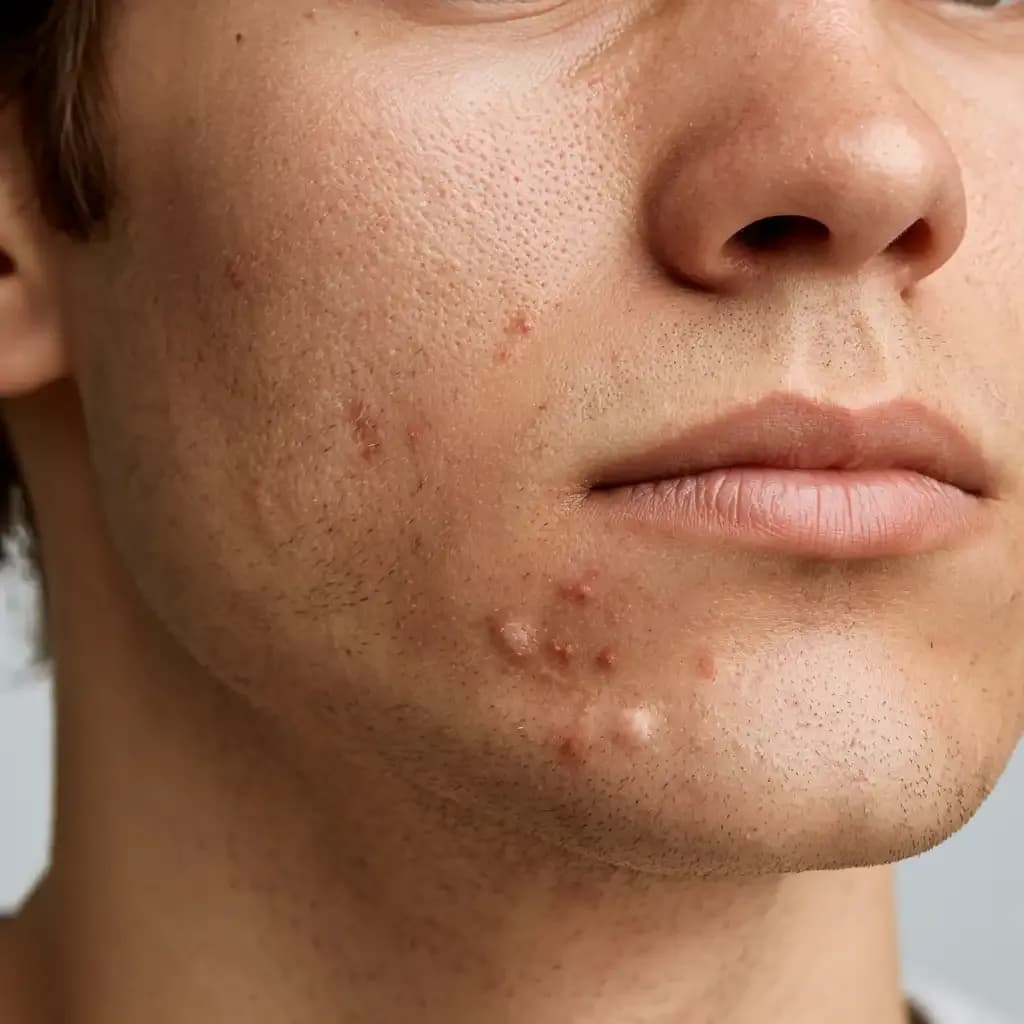
Red, swollen breakouts mean inflammation has set in around a follicle blocked with sebum and dead cells. Studies suggest a disrupted skin barrier and the follicular microbiome both feed this process, which is what separates acne from a plain blemish [1][3]. The table below compares how each lesion presents.
| Lesion | Inflamed? | What you see |
|---|---|---|
| Whitehead | No | Closed pore packed with sebum |
| Papule | Yes | Small red bump, no pus |
| Pustule | Yes | Red bump with visible pus [2] |
How Doctors Diagnose Inflammatory Acne by Symptom and Examination
Acne is diagnosed by examining the lesions and asking about your history, not by a single lab test [2]. What causes it is excess oil, sticky dead skin, bacterial overgrowth and an immune response converging in the follicle [3]. Anyone might get acne, though it's most common in teenagers and young adults with oily skin and a family history [1]. The symptoms a doctor looks for include:
- Red, tender papules and pustules, often on oily areas of the face, chest and back
- A flaring pattern that may leave a mark or scar
- Background blackheads and whiteheads where oil clogs pores
It isn't contagious. Rosacea and perioral dermatitis are the usual look-alikes, so a doctor weighs the full picture before settling on a diagnosis and a skincare plan. One sign alone rarely confirms it.
Inflammatory Acne What Cause Lies Beneath the Surface
Beneath the surface, the acne what cause story is excess oil, sticky dead cells, bacterial overgrowth and an immune response, all converging in the follicle [4][3]. Hormones, genetics, some medication and friction on the face make it worse, and diet may play a part too [5]. Deeper reactions can produce cystic lesions that scar [2].
The Main Type of Acne Lesions You'll See
The main type of acne lesions range from mild to severe. Papules and pustules sit at the milder end, while nodules and cystic acne are deep, painful and most likely to scar [4]. Knowing your type of acne, and which pore is involved, helps match treatment to depth [1].
Additional and Alternative Acne Treatment Options
Acne treatment is organised by class: topical retinoids like tretinoin and trifarotene to unblock the pore, anti-inflammatory actives such as azelaic acid and niacinamide, and antibiotics for moderate cases [2][6]. Chemical peels can help some patients as an adjunct [7]. Several options are prescription-only here, so the Prescription Skin pathway starts with an online assessment, a doctor's diagnosis, then a custom formula where appropriate. Early treatment also limits scar risk and the need for later acne scar treatment.
Smart Strategies to Prevent Future Breakouts
Preventing future breakouts means keeping the pore clear and the inflammation controlled over months, not days. Gentle exfoliation shifts dead skin, while a maintenance active keeps blackheads and oily buildup in check [8]. Antibiotic courses are short-term, so they're paired with a longer-term active to avoid resistance and relapse [9].
When to See a Doctor About Inflamed Pimples
See a doctor if an inflamed pimple is deep, painful, leaving scars, or not settling with over-the-counter care. Book a review if several inflamed pimples turn into nodules or cysts, if a pimple keeps recurring in the same spot, or if the inflamed area spreads quickly. Self-care isn't enough once scarring starts, and squeezing a pimple usually makes the inflamed bump worse, so it's better to avoid popping a pimple.
Self-Care Tips and Home Remedies Worth Trying
Sensible self-care supports treatment but won't fix this skin condition on its own. Use a mild cleanser twice daily, avoid harsh scrubbing that adds redness, and keep your skincare routine simple while actives do the work [8]. Skip antibiotic creams from the cupboard, since misuse drives resistance.
How to get it in Australia
In Australia, the stronger options for painful, inflamed acne are prescription-only, so you'll need a doctor rather than a shelf. You can see a dermatologist in person, or complete an online assessment where a doctor reviews your skin and, if suitable, prescribes a niacinamide-containing formula. A general skincare product can help with redness and inflammation but won't replace a prescription for moderate disease.
Side effects and safety
Most prescription acne actives are safe but cause some early irritation. Retinoids commonly bring dryness, redness and flaking for the first few weeks, and they can briefly worsen things before a cyst or blackhead settles. Tretinoin is contraindicated in pregnancy, and more painful inflammation may still need a dermatologist's input. Start low, build slowly, and report any severe reaction.
Who is and is not a candidate
Good candidates are people with persistent papules, the occasional pustule and the odd cyst that over-the-counter care hasn't cleared [10]. A topical retinoid suits most skin types, though sensitive or darker skin may need a slower start to avoid pigment changes. Pregnancy rules out tretinoin, and very oily skin with widespread pus-filled lesions and excess sebum often also needs adjunct treatment.
Summary
Acne is the red, swollen form of acne that responds well to the right combination of actives matched to lesion depth [1][2]. Prescription Skin's model lets an Australian-registered doctor assess your skin online and prescribe a formula where it's clinically appropriate.
Frequently asked questions
How do you get rid of inflammatory acne?
You get rid of acne by treating both the blockage and the inflammation, usually with a topical retinoid plus an anti-inflammatory active like azelaic acid, and antibiotics for moderate cases [2]. A doctor matches the plan to how deep and widespread the lesions are.
How do you know if your acne is inflammatory?
Your acne is likely inflammatory if the bumps are red, raised and tender, sometimes with visible pus, rather than the flat blackheads and whiteheads of non-acne [1].
Can a doctor prescribe treatment for inflammatory acne online?
Yes, a doctor can prescribe treatment for acne online after reviewing your skin assessment, where it's clinically appropriate. Prescription-only actives still require that doctor approval first.
Does it ever go away?
It often improves with age but can persist into adulthood, so think of it as a condition you manage rather than one that simply disappears [3].
What is stage 3 it?
Stage 3 refers to severe acne with numerous nodules and cysts and a high scarring risk, which needs prompt medical treatment [2].
What’s the difference: it vs noninflammatory acne?
The difference is inflammation: acne is red, swollen and tender, while non-acne is the painless blackheads and whiteheads caused by simple pore blockage.
References
- Deng Y, Wang F, He L. Skin Barrier Dysfunction in Acne Vulgaris: Pathogenesis and Therapeutic Approaches. Medical science monitor : international medical journal of experimental and clinical research. 2024. doi:10.12659/MSM.945336. PubMed ↩︎
- Eichenfield DZ, Sprague J, Eichenfield LF. Management of Acne Vulgaris: A Review. JAMA. 2021. doi:10.1001/jama.2021.17633. PubMed ↩︎
- Dréno B, Dagnelie MA, Khammari A, Corvec S. The Skin Microbiome: A New Actor in Inflammatory Acne. American journal of clinical dermatology. 2020. doi:10.1007/s40257-020-00531-1. PubMed ↩︎
- Fox L, Csongradi C, Aucamp M, du Plessis J, Gerber M. Treatment Modalities for Acne. Molecules (Basel, Switzerland). 2016. doi:10.3390/molecules21081063. PubMed ↩︎
- Ryguła I, Pikiewicz W, Kaminiów K. Impact of Diet and Nutrition in Patients with Acne Vulgaris. Nutrients. 2024. doi:10.3390/nu16101476. PubMed ↩︎
- Tan J, Chavda R, Baldwin H, Dreno B. Management of Acne Vulgaris With Trifarotene. Journal of cutaneous medicine and surgery. 2023. doi:10.1177/12034754231163542. PubMed ↩︎
- Conforti C, Zalaudek I, Vezzoni R, Retrosi C, Fai A, Fadda S. Chemical peeling for acne and melasma: current knowledge and innovations. Giornale italiano di dermatologia e venereologia : organo ufficiale, Societa italiana di dermatologia e sifilografia. 2019. doi:10.23736/S0392-0488.19.06425-3. PubMed ↩︎
- Xu H, Li H. Acne, the Skin Microbiome, and Antibiotic Treatment. American journal of clinical dermatology. 2019. doi:10.1007/s40257-018-00417-3. PubMed ↩︎
- Podwojniak A, Tan IJ, Sauer J, Neubauer Z, Rothenberg H, Ghani H. Acne and the cutaneous microbiome: A systematic review of mechanisms and implications for treatments. Journal of the European Academy of Dermatology and Venereology : JEADV. 2024. doi:10.1111/jdv.20332. PubMed ↩︎
- Conforti C, Giuffrida R, Fadda S, Fai A, Romita P, Zalaudek I. Topical dermocosmetics and acne vulgaris. Dermatologic therapy. 2020. doi:10.1111/dth.14436. PubMed ↩︎
Medically Reviewed Content
- Written by: Prescription Skin Editorial Team
- Medically Reviewed by: Dr Mitch Bishop - AHPRA Registered Practitioner (MED0002309948)
- Last Updated: June 2026
This content is for informational purposes only and does not constitute medical advice. Treatment is subject to consultation and approval by our Australian-registered doctors.
Part of our condition guide
Acne→