- Key takeaways
- What Is Perioral Dermatitis Around the Mouth?
- What Can Cause Acne Around Your Mouth?
- What Kinds of Spots Appear Around the Mouth?
- Which Face Washes Suit Acne Treatment Near the Mouth?
- How Can You Prevent Future Breakouts Near the Mouth?
- When Should You See a Doctor About Mouth Pimples?
- How to get it in Australia
- Side effects and safety
- Who is and is not a candidate
- Summary
- Frequently asked questions
Pimples around mouth areas are common, and they're not always what they look like. Many people assume any spot near the lips is acne, but a cluster of small red bumps around the mouth is often perioral dermatitis, a separate inflammatory condition that responds to different treatment. The distinction matters because the products that clear breakouts elsewhere can actually aggravate perioral skin. Understanding which one you're dealing with is the first step, and it's worth linking pimples around mouth to the broader picture of acne and skin barrier health before reaching for a treatment.
You may also find these related guides helpful: first 8 weeks on prescription skincare and 15 ways to reduce and treat acne scarring.
Key takeaways
- Pimples around the mouth can be true acne, but they're often perioral dermatitis, a different condition that needs different treatment.
- Common triggers include heavy occlusive products, fluoride or SLS toothpaste residue, lip balms, and friction along the chin and lip line.
- Treating perioral dermatitis like ordinary acne, especially with strong scrubs or topical steroids, usually makes it worse.
- Gentle, fragrance-free cleansing and non-comedogenic products help most milder cases settle.
- If spots are persistent, painful, or spreading, a doctor can confirm the diagnosis and prescribe targeted treatment such as azelaic acid or a topical antibiotic.
What Is Perioral Dermatitis Around the Mouth?
Perioral dermatitis is an inflammatory rash of small papules and pustules clustered around the mouth, often sparing a thin border right at the lip line. It can look like acne around the lips, but the mechanism differs. According to research on acne vulgaris, true acne is a chronic inflammatory disorder of the hair follicle and sebaceous gland unit[1], whereas perioral dermatitis is frequently linked to topical steroids and barrier irritation. The table below compares what you're seeing.
| Feature | True acne | Perioral dermatitis |
|---|---|---|
| Typical spots | Comedones, papules, pustules[2] | Small uniform red papules |
| Lip border | Involved | Usually spared |
| Helpful actives | salicylic acid, retinoids[3] | Often worsened by harsh actives |
Oral medication is sometimes needed for stubborn oral-area rashes, and an oral antibiotic course can settle severe cases.
What Can Cause Acne Around Your Mouth?
Acne around the mouth and chin usually comes down to clogged follicles, oil, and inflammation in a high-friction zone. Hormones are a big driver, which is why acne along the lower face and jaw often flares before a period or with conditions like PCOS. Acne in this area can also be mechanical: phones, hands resting on the chin, and face masks all rub the skin. Acne around makeup and skincare matters too, since heavy or occlusive products clog pores and can trigger acne around the mouth. Diet plays a smaller role, though research suggests gut balance and dietary patterns can influence skin inflammation and acne outcomes[4]. Acne is fundamentally a disease of the pilosebaceous unit[2], so to get rid of acne around the mouth you treat the cause, not just the surface. Gentle exfoliation with chemical acids helps, but scrubbing aggravates acne, and adapalene, a retinoid, is genuinely useful for comedonal acne when skin tolerates it. Acne that won't budge with these basics is worth assessing properly, since persistent acne around the mouth sometimes isn't acne at all.
What Kinds of Spots Appear Around the Mouth?
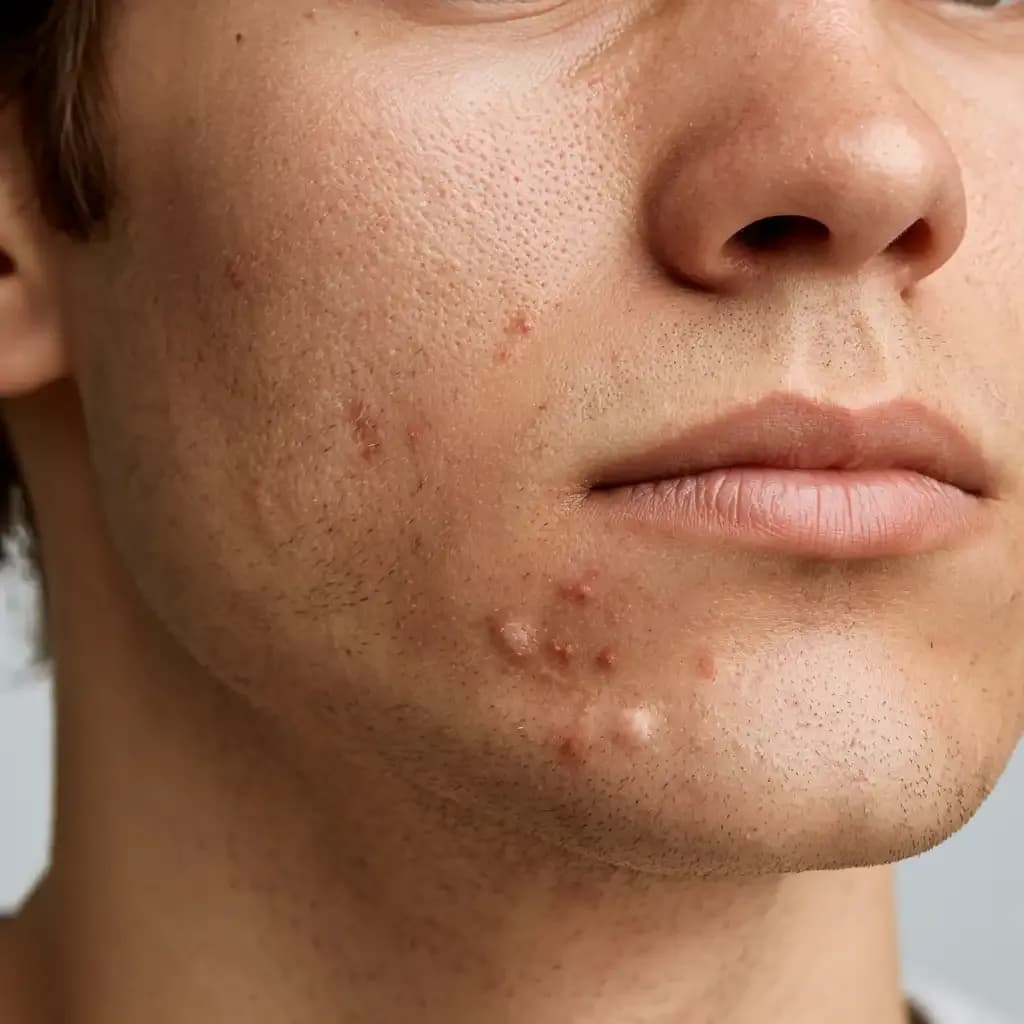
Several different spots show up near the mouth, and telling them apart guides treatment. Whiteheads and blackheads form when a pore blocks with oil and dead cells, while red papules and pustules involve bacteria and inflammation in the follicle[1]. Comedonal acne around the chin and lip line responds well to salicylic acid, which clears keratin from pores[3]. Small uniform bumps suggest perioral dermatitis instead, often tied to cosmetic and makeup residue rather than true acne. Matching your skincare to the actual spot type avoids wasted effort. Pimples around mouth skin can also be irritation from lip products, which mimics a breakout on the face.
Which Face Washes Suit Acne Treatment Near the Mouth?
A gentle, fragrance-free cleanser suits acne treatment near the mouth better than a harsh foaming wash. Acne in this zone sits on a sensitive part of the face, so stripping the skin barrier tends to backfire and worsen acne. For comedonal acne, a wash containing a low concentration of salicylic acid can help loosen pores, since acne treatment works best when it reduces follicular blockage without irritating skin[3]. Acne is an inflammatory condition[2], so calming acne care beats aggressive scrubbing every time. Acne around the mouth rarely improves faster with more product. Wash twice daily, no more.
How Can You Prevent Future Breakouts Near the Mouth?
Preventing future breakouts near the mouth starts with simplifying what touches that skin. Switch to a non-comedogenic moisturiser and check that lip balms and foundations aren't comedogenic, since heavy products clog the pore and cause acne around the chin. Avoid anything that might irritate the lip border, and rinse toothpaste and cleanser residue fully. A low-strength benzoyl peroxide can help inflammatory spots, though it can dry the skin, so introduce it slowly. Keep your skincare routine short and consistent. If spots keep returning despite this, a doctor or dermatologist can review whether acne or perioral dermatitis is the real cause and adjust treatment.
When Should You See a Doctor About Mouth Pimples?
See a doctor about mouth pimples when they're painful, spreading, scarring, or not responding to gentle skincare after several weeks. A persistent bump along the chin or lip that flares repeatedly may need prescription treatment rather than another non-comedogenic moisturiser. A doctor or dermatologist can confirm whether the cause is acne or perioral dermatitis, since the conditions that cause acne respond differently to topicals. Deep, tender nodules and anything that leaves marks deserve review, because untreated inflammation can damage the pore and skin. Reviewing your approach to picking at spots matters too, since squeezing makes scarring worse.
How to get it in Australia
In Australia, prescription-strength treatments for acne around the chin and mouth need a doctor's assessment and prescription. Topical antibiotics, azelaic acid at prescription strength, and oral options aren't available over the counter, so you can't simply buy them. Prescription Skin runs an online skin assessment where Australian-registered doctors review your skin and, where clinically appropriate, build a personalised prescription formula. That matters because the cause of acne, whether blocked pores, bacteria, or perioral irritation from makeup, changes what works. Working toward clear skin often means combining the right active with a simple skincare routine rather than chasing products that don't fit your skin.
Side effects and safety
Most topical acne treatments are safe but can irritate skin around the chin and lip, which are thin and sensitive. Expect some dryness, redness, or peeling early on, especially with retinoids and benzoyl peroxide. These can make perioral skin flare up before it settles, so introduce actives slowly. Don't use toothpaste on a spot, a common myth, since it irritates rather than helps. Azelaic acid is generally well tolerated and targets both bacteria and inflammation in the pore. Acne is an inflammatory disease of the follicle[5], and acne around the mouth also responds to addressing barrier health[1]. If pregnant or breastfeeding, check with your doctor first, since some ingredients aren't safe.
Who is and is not a candidate
Good candidates for prescription acne care are people with persistent inflammatory spots around the chin, lip, and pores that haven't responded to gentle over-the-counter products. A doctor or dermatologist can prescribe stronger options like azelaic acid or topical antibiotics when warranted[5]. Those whose acne around the mouth is really cosmetic irritation may just need to change products, and harsh actives like high-strength salicylic acid can worsen perioral skin. Don't put toothpaste on spots, and avoid stacking actives. Pregnancy, breastfeeding, and certain allergies change what's suitable, so prescription treatment always depends on assessment[2]. The pore-level cause guides the plan[3].
Summary
Pimples around the mouth may be acne or perioral dermatitis, and they need different treatment[1]. Prescription Skin's online assessment lets Australian-registered doctors review your skin and build a personalised prescription formula where clinically appropriate[2].
Frequently asked questions
What do pimples near the mouth mean?
Pimples near the mouth usually mean clogged or inflamed follicles, but a cluster of small red bumps can signal perioral dermatitis rather than ordinary acne. Hormones, friction, and heavy products are common triggers in this zone.
What does B12 acne look like?
B12 acne tends to look like sudden, uniform red papules and pustules on the face, particularly around the chin and mouth, appearing after high-dose vitamin B12 supplements. It often resembles perioral inflammation more than classic blackheads.
Can a doctor help with pimples around mouth?
Yes, a doctor can help with pimples around the mouth by confirming whether the cause is acne or perioral dermatitis and prescribing targeted treatment when appropriate. An accurate diagnosis matters because the two conditions need opposite approaches.
How to get rid of corner mouth pimples?
To get rid of corner mouth pimples, keep the area clean and dry, rinse off toothpaste and cleanser residue, and use a gentle non-comedogenic moisturiser. Avoid squeezing, and see a doctor if a spot is painful or recurring.
What does PCOS acne look like?
PCOS acne typically appears as deep, tender, inflammatory spots along the lower face, jaw, and chin, often flaring with the menstrual cycle. It's usually persistent and linked to hormonal changes rather than surface skincare.
What’s the Best Face Wash for Acne Around the Mouth?
The best face wash for acne around the mouth is a gentle, fragrance-free cleanser, sometimes with a low concentration of salicylic acid for comedonal spots[3]. Harsh scrubs aggravate this sensitive area, so gentler is better.
References
- Deng Y, Wang F, He L. Skin Barrier Dysfunction in Acne Vulgaris: Pathogenesis and Therapeutic Approaches. Medical science monitor : international medical journal of experimental and clinical research. 2024. doi:10.12659/MSM.945336. PubMed ↩︎
- Fox L, Csongradi C, Aucamp M, du Plessis J, Gerber M. Treatment Modalities for Acne. Molecules (Basel, Switzerland). 2016. doi:10.3390/molecules21081063. PubMed ↩︎
- Conforti C, Zalaudek I, Vezzoni R, Retrosi C, Fai A, Fadda S. Chemical peeling for acne and melasma: current knowledge and innovations. Giornale italiano di dermatologia e venereologia : organo ufficiale, Societa italiana di dermatologia e sifilografia. 2019. doi:10.23736/S0392-0488.19.06425-3. PubMed ↩︎
- Borrego-Ruiz A, Borrego JJ. Nutritional and Microbial Strategies for Treating Acne, Alopecia, and Atopic Dermatitis. Nutrients. 2024. doi:10.3390/nu16203559. PubMed ↩︎
- Dréno B, Dagnelie MA, Khammari A, Corvec S. The Skin Microbiome: A New Actor in Inflammatory Acne. American journal of clinical dermatology. 2020. doi:10.1007/s40257-020-00531-1. PubMed ↩︎
Medically Reviewed Content
- Written by: Prescription Skin Editorial Team
- Medically Reviewed by: Dr Mitch Bishop - AHPRA Registered Practitioner (MED0002309948)
- Last Updated: June 2026
This content is for informational purposes only and does not constitute medical advice. Treatment is subject to consultation and approval by our Australian-registered doctors.