- Key takeaways
- Understanding Acne Scarring and Why It Happens
- How to Recognise Acne Scars on Your Skin
- What Causes Acne Scars to Form
- The Different Types of Acne Scars
- Acne Scarring Treatment Options That Actually Work
- How to Prevent Acne Scars From Forming
- When to See a Doctor About Acne Scars
- Book Your Acne Scarring Assessment Today
- Start Your Personalised Scar Treatment Plan
- Summary
- Frequently asked questions
Acne scarring treatment covers everything used to smooth, fade, and repair the marks acne leaves behind, from prescription creams you use at home to procedures done in a clinic. The first thing worth sorting out is what you're actually looking at. The word "scar" gets used loosely, but a flat red or brown mark is a pigment change, whereas a true scar is a dent or raised lump where collagen has been lost or overproduced during healing.[1]
Scarring is far more common than most people expect. According to Tan and colleagues, a large share of people who see a dermatologist for acne have some degree of scarring, and the risk climbs with more severe or longer-lasting breakouts.[2] That's the frustrating part: the acne clears, but the reminder stays.
The good news is that acne scarring treatment genuinely works when it's matched to the right scar type, and a lot of the outcome depends on getting in early. Research on topical retinoids shows they don't just fade existing marks; used early they can reduce how many atrophic scars form in the first place.[3] For deeper, established scars, a combined plan of topical actives plus in-clinic procedures gives the most reliable improvement.[4] If you're still dealing with breakouts, treating the underlying acne is part of the same conversation. This page walks through what causes scars, how to tell them apart, and what actually shifts them.
You may also find this related guide helpful: prescription skincare during pregnancy.
Key takeaways
- Marks are not scars: flat red or brown marks (post-inflammatory erythema and hyperpigmentation) are colour changes that usually fade on their own, while true acne scars like ice pick, boxcar, and rolling scars involve lost or altered collagen and change the skin's texture.[1]
- Prevention beats repair: treating active acne early, particularly with topical retinoids, is the single most effective way to stop atrophic scars developing.[3]
- Scar type drives treatment: topical actives fade pigment and refine shallow texture, but deep atrophic scars usually need in-clinic procedures like TCA CROSS, subcision, microneedling, or laser resurfacing.[4]
- Scarring is common and worth reviewing: a large proportion of people with acne develop some scarring, and earlier, more severe acne carries higher risk.[2]
Understanding Acne Scarring and Why It Happens
Acne scarring happens when a breakout inflames the skin deeply enough to damage collagen, and the repair that follows leaves either too little tissue (a dent) or too much (a raised lump). According to Fabbrocini and colleagues, most acne scars are atrophic, meaning the skin heals with a net loss of collagen and sits below the surrounding surface.[1] Deeper, more inflammatory lesions and delayed treatment both push the risk up, which is why early acne scarring treatment focuses on calming inflammation fast.[2]
Matching the mark to its usual treatment class helps set realistic expectations.
| Type | What it looks like | Usual treatment class |
|---|---|---|
| Ice pick | Deep, narrow puncture-like pits | TCA CROSS, punch excision |
| Rolling | Soft, wave-like depressions | Subcision, hyaluronic acid filler |
| Boxcar | Round dents with sharp edges | Laser resurfacing, microneedling |
| Post-inflammatory marks | Flat red or brown patches, not true scars | Retinoids, azelaic acid |
Flat marks usually settle over months, while true collagen scars rarely resolve without active treatment.[4]
How to Recognise Acne Scars on Your Skin
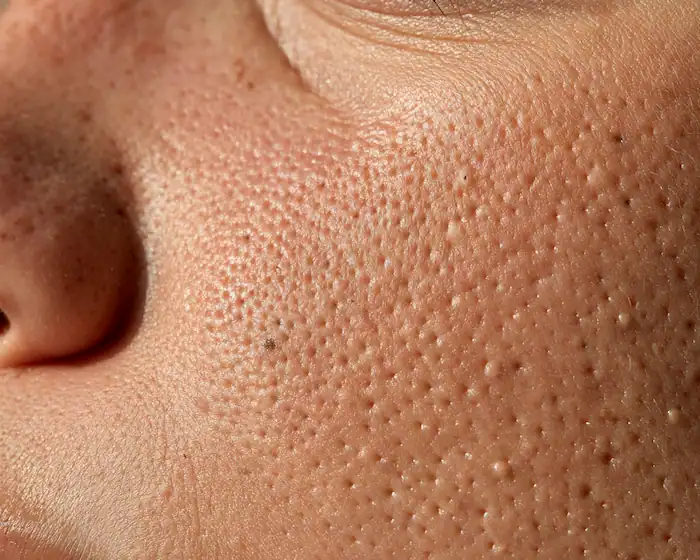
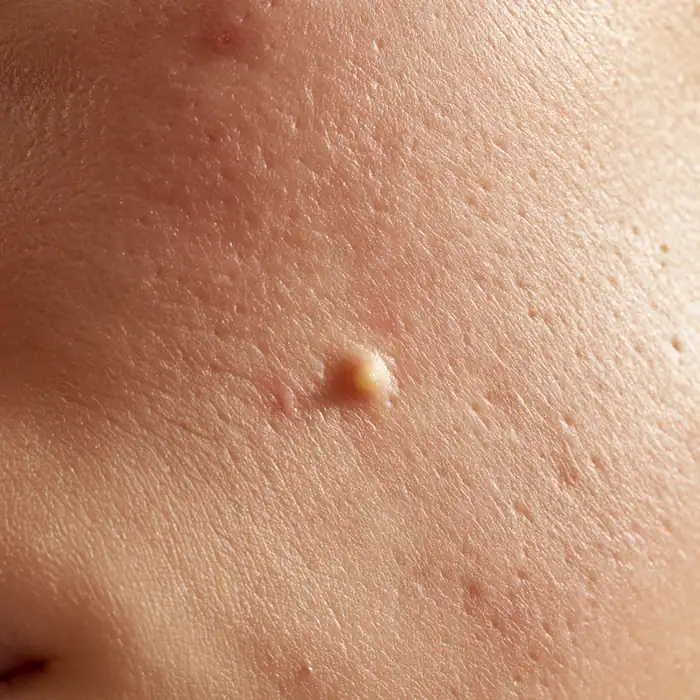
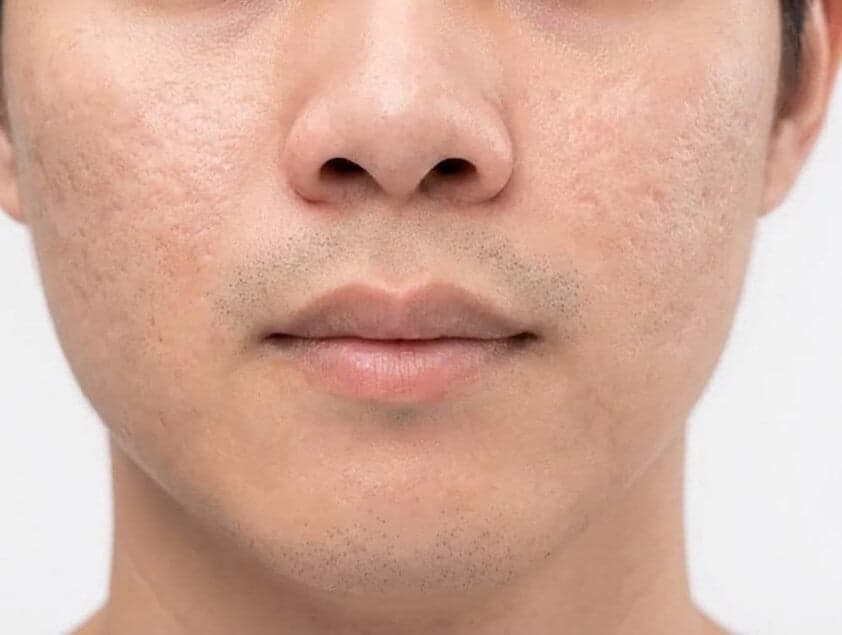
You can usually tell a true acne scar from a temporary mark by running a finger over the skin and checking whether the texture has changed. A scar you can feel as a dent or a firm raised bump; a mark you can only see. Findings consistent with acne scarring include:
- Small, deep pits that look like the skin has been pricked (ice pick).
- Broader depressions with sloping or sharp edges that catch shadow in side lighting (rolling and boxcar).
- Firm raised lumps sitting above the skin, most often on the jaw, chest, or back (hypertrophic or keloid).
- Flat red, purple, or brown patches where a pimple used to be, with no change in texture (post-inflammatory marks).
Scars turn up wherever acne was inflamed, so the cheeks, temples, jawline, chest, and back are common sites. Flat marks are often confused with genuine scars, and both can be mistaken for hyperpigmentation from other causes or the redness of rosacea. Because early treatment changes the outcome, a doctor's assessment is worth it before you decide something is permanent.[3]
What Causes Acne Scars to Form
Acne scars form when inflammation from a breakout ruptures the pore wall below the surface and damages the collagen framework faster than the skin can rebuild it cleanly. According to Tan and colleagues, the strongest drivers are the severity and duration of the acne itself, plus how long it goes untreated before someone gets help.[2] Deep, inflamed cysts and nodules do far more collagen damage than surface whiteheads, which is why nodulocystic acne scars so readily.[1]
Picking and squeezing make things worse in a very direct way. Pressing on a lesion forces its contents deeper into the dermis, spreads the inflammation sideways, and turns a spot that might have healed flat into a lasting dent. A family history of scarring and skin that scars readily elsewhere also raise the odds.
The practical takeaway is that the earlier active acne is brought under control, the less raw material there is for scars to form, which is exactly why retinoid-based treatment started early matters.[3]
The Different Types of Acne Scars
Acne scars fall into two broad groups, atrophic (depressed) and hypertrophic (raised), and getting the category right is what lets you treat acne scarring sensibly rather than throwing random creams at it. Atrophic scars are the most common and split into three recognised shapes.[1]
- Ice pick: narrow and deep, like a tiny puncture that goes straight down. These are the hardest to treat with surface methods.
- Boxcar: round or oval depressions with well-defined, near-vertical walls, often on the cheeks and temples.
- Rolling: wide, shallow dips with soft sloping edges, caused by fibrous bands tethering the skin down from below.
Hypertrophic and keloid scars are the opposite problem: raised, firm tissue from too much collagen, more common on the chest, shoulders, and jaw.[2] Many people have a mix of types on the same face, which is normal and means a single treatment rarely addresses everything.[3]
Acne Scarring Treatment Options That Actually Work
Acne scarring is treated by combining topical actives for pigment and shallow texture with in-clinic procedures for deeper collagen loss, and the best plan starts with a correct diagnosis. According to Connolly and colleagues, no single method suits every scar, so treatments are chosen by class and layered over time.[4]
Topical prescription actives. Prescription retinoids such as tretinoin speed cell turnover and stimulate collagen, fading marks and refining shallow scars; they're prescription-only in Australia and started at a low strength to limit irritation.[3] Azelaic acid and niacinamide help settle post-inflammatory redness and pigment.
In-clinic procedures. Deeper atrophic scars respond to TCA CROSS for ice pick scars, subcision for tethered rolling scars, microneedling, and laser resurfacing to rebuild collagen.[4]
With Prescription Skin, the pathway is an online skin assessment, a review and diagnosis by an Australian-registered doctor, and a custom prescription formula built around your scars and any active acne, where clinically appropriate. That combination of home treatment and clinic procedures gives the most durable result.[2]
How to Prevent Acne Scars From Forming
The most reliable way to prevent acne scars is to treat acne early and well, before repeated deep inflammation gets a chance to damage collagen. According to Layton and colleagues, topical retinoids used early can reduce the number of atrophic scars that form, not just fade the ones already there.[3] Keeping the underlying acne controlled matters more than any scar-specific product.
Two everyday habits do the heavy lifting. Leaving spots alone rather than squeezing them prevents the deep dermal rupture that turns a pimple into a permanent dent, and daily broad-spectrum sunscreen stops post-inflammatory marks darkening while protecting healing collagen from UV breakdown.[5]
Set realistic timelines. Flat marks can take three to twelve months to fade, and collagen remodelling after a procedure continues for months afterward.[1] Ongoing maintenance with a retinoid and sun protection holds the results and keeps new scarring at bay.
When to See a Doctor About Acne Scars
See a doctor when you still have active, inflamed acne alongside your scars, because untreated breakouts keep generating new damage no matter what you do about existing marks. Any type of acne that is deep, cystic, painful, or leaving fresh scars each month needs medical review rather than shop-shelf products.[2]
Other signals worth a review include raised or thickening scars that are growing rather than settling, scars that are affecting how you feel day to day, and marks that haven't budged after several months of consistent home care. Because effective acne scar treatments like TCA CROSS, subcision, and laser resurfacing carry real risks in the wrong hands, they belong with a clinician who can match the technique to your scar type and skin tone.[1]
Self-care with sunscreen and a gentle routine is reasonable for flat, fading marks, but it won't rebuild lost collagen. Getting assessed early keeps more of your options open.[3]
Book Your Acne Scarring Assessment Today
An acne scarring assessment gives you a clear read on which scar types you actually have and which treatments are realistic for them, rather than guesswork from a mirror. With Prescription Skin, that starts with an online skin assessment where you share photos and history, which an Australian-registered doctor reviews to reach a diagnosis.
Because scarring risk tracks so closely with how severe and how long-standing the acne has been, an early review is genuinely useful even if your breakouts have mostly settled.[2] The doctor can tell apart flat post-inflammatory marks, which often improve with topical actives, from true atrophic scars that may need in-clinic procedures as well.[4]
Where it's clinically appropriate, the outcome is a custom prescription formula built around your skin, often pairing a retinoid with ingredients that target pigment and redness. If you want a sense of what the first stretch of treatment feels like, our guide to your first 8 weeks on prescription skincare sets expectations. Starting early keeps the results achievable.[3]
Start Your Personalised Scar Treatment Plan
A scar treatment plan works best when it addresses both the marks and any active acne at once, because whichever type of acne is still flaring will keep undoing your progress. Treatment is organised by class: topical actives for maintenance and shallow marks, and clinic procedures for deep collagen loss.[1]
With Prescription Skin, the pathway is straightforward. You complete an online skin assessment, an Australian-registered doctor reviews it and makes a diagnosis, and where clinically appropriate they build a custom prescription formula. That formula may combine tretinoin with azelaic acid or niacinamide to work on texture, pigment, and redness together, and tretinoin is prescription-only in Australia, so it isn't something you can pick up over the counter.[3]
For deeper atrophic scars, the doctor may recommend pairing your formula with in-clinic procedures such as microneedling or laser.[2] If pigment is your main concern, our guidance on hyperpigmentation is a useful companion. The plan is reviewed as your skin responds.
Summary
Acne scars come in two families, depressed atrophic scars and raised hypertrophic scars, and they behave very differently from the flat red and brown marks that fade on their own.[1] The most effective approach is to treat active acne early, protect the skin with daily sunscreen, and match each scar type to the right treatment class, pairing topical actives with in-clinic procedures for deeper damage.[2] With Prescription Skin, the next step is an online skin assessment reviewed by an Australian-registered doctor, who can build a custom prescription formula where it's clinically appropriate.
Frequently asked questions
What is the best treatment for acne scarring?
The best treatment for acne scarring depends on the scar type, so there's no single answer for everyone. Flat marks usually respond to topical retinoids and azelaic acid, while deep atrophic scars often need procedures like TCA CROSS, subcision, microneedling, or laser resurfacing. A doctor's assessment matches the method to your scars.
Is it possible to 100% get rid of acne scars?
No, it's not usually possible to remove acne scars completely, and any service promising a total cure should be treated with caution. Well-chosen treatment can make scars significantly less noticeable, sometimes dramatically so, but true collagen scars can rarely be erased to nothing. Realistic goals get better results.
Can a doctor prescribe acne scarring treatment online?
Yes, an Australian-registered doctor can review your skin online and, where clinically appropriate, prescribe topical treatment for acne scarring. With Prescription Skin you complete an online skin assessment, a doctor assesses it, and a custom prescription formula follows only after that review. Deep scars may still need in-person procedures.
How can I remove my acne scar?
You remove or reduce an acne scar by matching the technique to the scar: retinoids and azelaic acid for pigment and shallow texture, and procedures such as microneedling, laser, subcision, or TCA CROSS for deeper dents. Raised scars are usually treated with corticosteroid injections rather than resurfacing.
How can I fade acne scars fast?
There's no genuinely fast fix for acne scars, but you can speed fading of flat marks with a prescription retinoid, azelaic acid, and daily broad-spectrum sunscreen to stop them darkening. Expect several months for visible change. Anything advertised as an overnight result won't touch true collagen scarring.
References
- Fabbrocini G, Annunziata MC, D'Arco V, et al. Acne scars: pathogenesis, classification and treatment. Dermatology Research and Practice. 2010;2010:893080. doi:10.1155/2010/893080. PubMed ↩︎
- Tan J, Kang S, Leyden J. Prevalence and Risk Factors of Acne Scarring Among Patients Consulting Dermatologists in the USA. Journal of Drugs in Dermatology. 2017;16(2):97-102. PubMed ↩︎
- Tan J, Tanghetti E, Baldwin H, et al. The Role of Topical Retinoids in Prevention and Treatment of Atrophic Acne Scarring: Understanding the Importance of Early Effective Treatment. Journal of Drugs in Dermatology. 2019;18(3):255-260. PubMed ↩︎
- Connolly D, Vu HL, Mariwalla K, et al. Acne Scarring-Pathogenesis, Evaluation, and Treatment Options. Journal of Clinical and Aesthetic Dermatology. 2017;10(9):12-23. PubMed ↩︎
- The Clifford Clinic. Say Goodbye to Acne Scars: Why Sunscreen is Your Best Ally. The Clifford Clinic Blog. 2024. ↩︎
Medically Reviewed Content
- Written by: Prescription Skin Editorial Team
- Medically Reviewed by: Dr Mitch Bishop - AHPRA Registered Practitioner (MED0002309948)
- Last Updated: July 2026
This content is for informational purposes only and does not constitute medical advice. Treatment is subject to consultation and approval by our Australian-registered doctors.
Part of our condition guide
Acne →